

During the Islamic invasions across various parts of the country, the deaths of invaders were documented as martyrdom. In their memory, tombs were converted into mosques. Sometimes, temples were converted into mosques, or new structures were built to assert dominance. One such structure is the Bara Shaheed Dargah in Nellore. Despite the lack of authentic references or historical evidence, popular stories glorify the Muslim invaders.
The Bara Shaheed Dargah, situated beside a lake in Nellore town of Andhra Pradesh, gains attention annually following the Muharram festival. This coincides with the celebration of ‘Rottela Panduga’, a popular event where ‘Rotella’ (the Telugu plural of ‘Roti’) plays a central role. The Muslim lobby was successful in convincing then Andhra Pradesh government in 2015 and declared it as a state festival. Since then, the event draw lakhs of Muslims and non-Muslims not only from AP but also from Tamil Nadu, Karnataka and other states.
However, a definitive history directly related to the Bara Shaheed Darga where this Rottela Panduga takes place has not been found yet. Some alternative stories are currently being promoted locally. These divergent narratives are raising doubts about the authenticity of the actual history of Bara Shaheed Darga.
According to such local folklore, the origin of Bara Shaheed Dargah is steeped in legend. One account suggests that twelve Islamic preachers from Turkey arrived in India to spread Islam through Tablighi (- (Da’wah-proselytizing). Their journey brought them to Gandhavaram, where they faced resistance from the locals. This resistance escalated into a battle, resulting in the death of the twelve Islamists. The current dargah stands as a memorial at the site where they were killed.
Another version is, during the Carnatic Wars in 1751, the Nawab of Arcot enlisted a regiment from Turkey to aid in the conflict against the British. Among these soldiers were twelve individuals who were truly religious in practices, performing Namaz five times daily and observing all tenets of their Islamic faith. Despite their regiment’s victory, these twelve Islamists were beheaded by enemy forces during the battle at Gandavaram, located 15 km from Nellore. Their headless bodies were returned to Nellore atop the very horses they rode into battle, and they were laid to rest at the site where the present-day Dargah stands. This area subsequently gained renown as Bara Shaheed Dargah in their honor, with the Dargah constructed to commemorate their sacrifice.
Therefore, the shrine is named ‘Bara Shaheed Dargah’, where ‘Bara’ signifies twelve and ‘Shaheed’ denotes martyrs. Legend has it that news of the warriors’ ability to fulfill the wishes of the faithful spread widely after the wife of the Nawab of Arcot recovered from a severe illness upon offering prayers at the tombs of these twelve Islamists.
‘Roti Festival’ or ‘Rottela Panduga’:
Since the Dargah was built, Muslims would gather on ‘Moharram’ and share rotis with each other the following day. Over time, word spread that sharing rotis at the Dargah would bring good fortune to both the donor and the receiver. As a gesture of reverence, the queen, accompanied by the Nawab, distributed Rotis among the local Muslims, and subsequently to the local non-Muslims. Since then, Muslims used to gather at the Dargah on the 12th day of the Muharram month to continue the tradition of sharing Rotis. The exchange of these Rotis occurs at Nellore tank, also known as ‘Swarnala Cheruvu’, situated near the dargah.
Slowly Hindus began attending the Dargah, believing it to be a sacred place and hoping that offering food there would bring them luck too. The story of the Dargah’s purported blessings became widely popular. Unaware of the Islamic invaders’ history and its implications, Hindus joined in these rituals, anticipating that it might bring them good fortune. In recent decades, this belief was hugely publicized, attracting a large number of people from nearby areas.
Capitalising this food sharing activity, Roti vendors with motive of huge profits, started innovative and customized method by branding the rotis according to the devotees’ wishes. Rotis are named as Sowbhagya (good fortune) roti, Vidya (education) roti, Udyoga (employment) roti, Vivaha (marriage) roti, Santana (children) roti, Dhana (money) roti, and even Visa roti.
Shia Origins of Bara Shaheed Dargah
The Rot(i) festival, observed the day after the Muharram festival, along with the historical association of Arcot Nawabs with the shrine, and the tradition surrounding the 12 Shia Muslim death, strongly suggest the Shia origins of this shrine. The Arcot Nawabs represented three distinct lineages: Zulfikar Khan and Daud Khan Panni, who were appointed by Aurangzeb initially, succeeded by the Nawayati Nawabs. In the 1740s, the Wallajah line of Nawabs emerged. The early Nawabs adhered to the Shia branch of Islam, while the later Nawabs followed Sunni Islam.
History of Muharram:
The Battle of Karbala occurred on 10 October 680 A.C.E (10 Muharram, 61 AH in the Islamic calendar). It was fought between the army of the second Umayyad Caliph, Yazid I, and a small army led by Husayn ibn Ali, the grandson of the Islamic Prophet Muhammad, at Karbala, located in present-day Iraq.
The family members of Imam Husain were taken as prisoners of war, shackled, and forced to march barefoot from Kufa to Damascus. During this harsh journey, several young children died due to the brutal conditions and ill-treatment. The captives were paraded through multiple towns, where they faced humiliation and assault from onlookers. Yazid ordered the city to be decorated, and jubilant crowds gathered to celebrate the capture of the prisoners. In Damascus, the heads of Imam Husain and his companions were publicly displayed and subjected to further humiliation. The family of Imam Husain was paraded through the marketplace, where some historians report that bystanders attacked them with stones, rubbish, and even hot water. This episode is considered one of the most tragic chapters in Islamic history, as such harsh treatment was unimaginable for the beloved grandson of Prophet Muhammad (SAW).
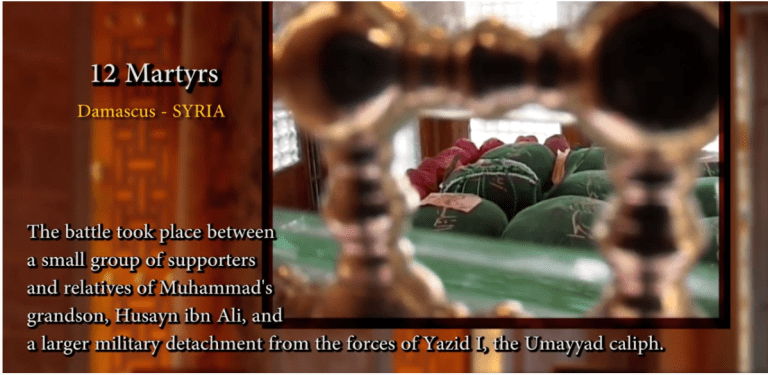
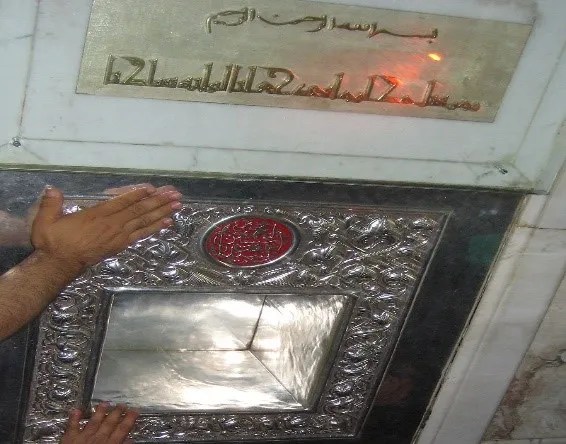
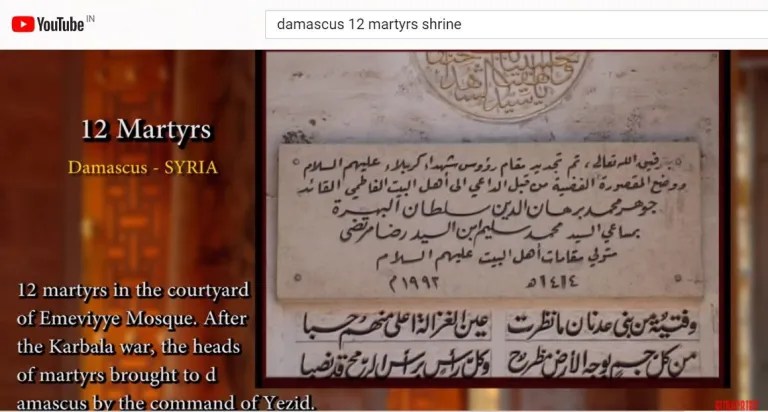
A memorial to the 12 martyrs of Shia Islam was constructed at the Umayyad Mosque in Damascus, Syria. Inside the memorial, cloth bundles representing the heads of the martyrs are displayed. The beheading of the martyrs of Karbala and the subsequent transportation of their severed heads to Damascus in 680 A.C.E. has been transformed into folklore surrounding the Bara Shaheed Dargah in Nellore, Andhra Pradesh, and given a local context. The tale of the martyrs’ heads falling at the present location parallels the events that occurred after the Battle of Karbala in 680 A.C.E.
12 Martyrs’ Memorial in Damascus – Niche for Imam Hussain’s Head in Mosque
The exchange of a special type of biscuit called ‘Rot’ during Muharram is a tradition in the Indian subcontinent. This tradition has evolved into the festival known as ‘Rottela Panduga’. The custom of exchanging ‘Rot’ by devout Muslims during Muharram highlights the connection between the legend surrounding the Bara Shaheed Dargah and the Battle of Karbala, including the beheading of the martyrs. The celebration of ‘Rottela Panduga’ a day after the Muharram mourning period clearly indicates that the shrine’s origins are rooted are attempts to connect local events with the Battle of Karbala and the martyrdom of the 12 Shia martyrs where neither any documentation and history evidence was available till date.
Source: This article was originally published in Dakshinapatha

 Arise Bharat
Leave a comment