
Excerpts from the book “RSS – A Vision in Action”

INDEPENDENT BHĀRAT stood aghast, faced with a grim challenge to all its cherished political values, when Emergency was clamped on 25th June 1975.
“My world lies in shambles all around me. I am afraid I shall not see it put together again in my lifetime”. It was with such heart-rending sentences that Loknāyak Jayaprakash Narayan began writing his prison diary, while he was detailed in Chandigarh in the wake of Emergency.
Indeed, it reflected the mental condition of the entire people. The thunderbolt of Emergency on 26th June 1975 has left the country benumbed. The basic freedoms of the people had been extinguished. The press was gagged. Courts were castrated. Parliament paralyzed. The Sangh was banned. An entire nation of 600 million has overnight been pushed from freedom to slavery. As days went by, the gloom deepened.
This internal slavery was in a way more suffocating than the preceding one – the slavery under the British. Black-out of news was total. Not a single word appeared about the protests or even the whereabouts of arrested national leaders. Added to this was the barrage of character assassination let loose by the Government, against the imprisoned leaders and banned organisations, especially Sangh. The radio, the television documentaries and an obliging press – all joined the chorus. Emergency was praised to the skies. The new discipline, the 20-point programme, putting the derailed democracy back on rails, saving the country from lawlessness and subversion because of JP’s call to police and military – all such slogans became the hallmarks of the new order.
Has Bhārat Succumbed?
It appeared that Indira Gandhi had successfully replied at one stroke to all the challenges posted to her. The people’s revolution of JP, the hostile press, the adverse result of Gujarat elections, the judgement of Allahabad High Court, the dairy exposures in Parliament of corruption and criminality in high places – all these had been silences at one stroke. The democratic world was taken aback. They could not believe that the largest democracy in the world could go under so easily without a whimper of protest. The world at large felt that Bhārat was in for a long spell of dictatorship. There seemed to be absolutely no way out. It was all unrelieved darkness – without a single streak of light.
However, fortunately for the nation, this was not the whole story. Though for all outward appearances the nation was silent as a grave, there was underneath, a volcanic simmering. Gradually it grew more and more intense and finally erupted at the first occasion.
The elections of March 1977 became the Krurukshetra where the forces of all that is good and great in the people were ranged against the brutal forces of oppression and tyranny mobilized by a despotic government. And the forces of good won. The people’s power triumphed over the power of the dictator. The joy of liberation was unprecedented. The dark night had passed. The Sun of Freedom had again dawned.
A miracle had taken place. The anti-climax had overnight turned into a more dramatic climax.
What were, then, the forces which brought about this change – a change which was beyond the fondest of hopes and wildest of imagination? And, which was the chief force among them round which all others could be gathered and forged into a powerful movement of people’s resistance?
The Key Instrument
M.C. Subramanyan, a veteran journalist and editor of The Indian Review, Madras, wrote in its issue of April’ 1997: “Among the groups which carried on this work with heroic persistence, the RSS group stands out for special mention. In organizing Satyagraha, in maintaining the all-India communication network, in quietly collecting money to finance the movement, in arranging the distribution of literature without any bottleneck and in offering help to fellow prisoners of other parties and other faiths in the jails, they proved that they constitute the nearest answer to Swāmi Vivekananda’s call for an army of sannyasins, to take up social and political work in this country. They are a conservative revolutionary force who have won the admiration of fellow political workers and respect of even their erstwhile political opponents.”
Describing the underground movement in India as “the only non-left revolutionary force in the world,” the prestigious London Economist in its issue of 4th December 1976 said that “it is dominated by tens of thousands of RSS cadres, though more and more young recruits are coming and its platform at the moment has only one plank: to bring democracy back to India.”
Looking at the heroic manner in which the Swayamsevaks were carrying on Satyagraha facing the brutal assaults of the police, even A.K Gopalan, Marxist MP, was moved to say: “There is some lofty ideal which is capable of inspiring such deeds of bravery and stamina for sacrifices.”
The stories of Emergency written by eminent journalists such as D.R. Mankekar and B.M. Sinha bear out the same truth with telling details.
The RSS! Well, that was the nucleus, the chief rallying point.
The stunning impact of Emergency was caused by the total snapping of all types of communication lines – the Press, the platform, the Postal Services and the elected assemblies having been immobilized. That had rendered a country-wide mobilization of opposition to Emergency beyond the power of any other organization. The Rashtriya Swayamsevak Sangh with its network of Shakhas, covering the entire stretch of the country, was the one organization cut out for this role. The Sangh, right from its inception, had built itself through a technique of man-to-man contact. It has never depended upon press or platform for its mutual links and communication with the people. As such, the shutting off of the channels of communication which had paralyzed the political parties did not affect the Sangh in the least. The decisions taken at the central all-Bhārat level were carried to the provincial level; from there to the division and then to district and tehsil and village. The channels worked excellently right from the day Emergency was clamped to the day it was lifted. And this, in spite of the arrests of thousands of its workers.
The communication links were not limited to the Sangh cadres alone. It encompassed all the forces of Opposition. Achyut Patwardhan wrote (Indian Express, 9th June 1979): “I was happy to see that they [Swayamsevaks] were prepared to work with zeal and devotion along with any other group of political resistance, to cooperate and participate freely with all who were opposed to the diabolical regime of suppression and falsehood. Experience of those who lived with RSS leaders and hundreds of others in jails fully corroborates this impression.”
At the very start, Nanaji Deshmukh was given complete authority by Jayaprakash Narayan to organize underground resistance as the Secretary of Lok Sangharsh Samiti (LSS). However, he soon became a prize-catch to the police. Then Ravindra Verma took over the reins. He belonged to the Congress-O. His experiences of working with the Sangh cadres make a revealing reading. In his letter dated 22nd December 1975, to the chief Sangh organizer of the Karnataka unit of LSS, he wrote: “I was very happy and thrilled to hear reports from your province. I know how much of planning and work from all of you have gone into produce this result. I have had the highest appreciation and affection for your whole team of friends ever since I came in touch with you and other friends. What you have worked for and achieved is an inspiring example to many others.”
The homes of Sangh worked proved to be among the greatest assets for the network of the underground movement. And it was to this factor that Intelligence officers too owed their defeat in tracing the whereabouts of the underground workers or their meeting places. The houses provided shelter not only for Sangh workers but to all others in the LSS. No distinction was ever made. Karpuri Thakur, for example, was often sheltered in the Sangh homes.
The Shakhas now became the dynamic underground centers for the contacting and mobilizing of all the fighting cadres. They were the radiating centers of inspiration and guidance, mutual trust and cooperation. And all this right from within a few days of the clamping of Emergency. Balasaheb Deoras had, on the 27th of June, issued a call to all the Swayamsevaks to accept the challenge of Emergency and to leave no stone unturned in rousing and mobilizing the people for the coming struggle.
Shattering Government’s Credibility
The most crucial challenge lay in establishing live communication links with the masses and delivering to them the message of the struggle. Underground literature was the only way out. Here too, the Sangh machinery rose to the occasion. Houses of Swayamsevaks became the centers of duplicating machines. Even clandestine presses were established. Hundreds of daring printers too, came forward throughout the country. And this was the biggest worry and challenge to the government. Fortnightly bulletins under numerous names would come out with unfailing regularity, and all over the country. District newsletters would be summarized at the provincial level and then conveyed to the center. The central all-Bhārat bulletin would then be sent from there to all the provinces. Regular supply of such news to foreign correspondents such as Jack Anderson and George Laizle of Newsweek of USA went out from New Delhi. After a time, a central bulletin Satya Samachar came to be issued regularly from there. Small booklets laying bare the hideous face of Emergency were published. Special appeals addressed to students, labour, women, farmers, journalists, lecturers and industrialists were distributed to those sections. The inspiring incidents of the struggle in different parts of the country, accounts of the stalwarts who had joined the fray, their fiery messages, echoes of the struggle from abroad, biting cartoons, slogans, call to the people on special occasions such as August 9 and August 15, Gandhi Jayanti, Vijayadashami, Sankranti, June 26, etc – all these were lapped up by the waiting people. In contrast to the regular newspapers which had virtually become government organs, these underground bulletins became the people’s papers.
The Open Struggle
The underground movement became overground whenever the slightest chance offered itself. The birthday of Gandhiji on 2nd October 1975 was made an occasion to distribute and display badges and posters bearing Gandhiji’s message: “To bend before untruth and injustice is cowardice”. Ofcourse, the police came down heavily even on this campaign and hundreds of workers were put behind bars.
The visit of foreign delegates to the Commonwealth Conference at New Delhi in the last week of October 1975 was yet another opportunity which the LSS eagerly seized. The opposition group from Bhārat invited to the Conference registered a resounding protest on the floor of the Conference itself. Later on, the public reception to the delegates arranged in the historic Ref Fort witnessed a daring demonstration by Satyagrahis – all of them Swayamsevaks – strict security precautions taken by the authorities notwithstanding. The New York Times (9th November 1975) of USA carried a scintillating report of these incidents which came as a shocking revelation to the entire free world.
An excellent chance was offered to the LSS workers to arouse the public at large, when the Government allowed a very limited scope for public debate on the proposed 42nd Amendment to the Constitution. The Government’s intentions were obvious. They wanted to make a pretence of ascertaining the democratic will of the people. But even this chance was not to be missed. The entire underground machinery of the Sangh swung into action. From the all-Bhārat level down to the district level, seminars and conferences were organized. Writers, journalists, political leaders, educationists and lawyers were contacted and persuaded to join the struggle on the constitutional front. The result was, indeed beyond expectation. Inspiring and soul-stirring scenes of public enthusiasm and response were witnessed. Evidently the nation’s conscience had been aroused.
The mobilization was not confined to the intellectuals. It was taken to the slums and rural populace. Religious festivals, bhajans, medical service, tutorial classes, youth clubs – all these gradually became instruments of mass-awakening. It must be remembered, all this was being undertaken by the Sangh at a time when over 100,000 of its active Swayamsevaks were behind bars.
Pooling of funds, too, developed entirely on the underground network. The quick movements of thousands of underground workers, cyclostyling and printing of bulletins, maintenance of families whose main earning members had been jailed under MISA (“Maintenance of Internal Security Ordinance“, Act)– all these required lakhs of rupees in every province. At the national level a prominent leader, Sangh pracharak, moved all over the country for this purpose. But the lion’s share of contributions came from the Swayamsevaks and sympathizers.
Vindicating a Trust
One of the crucial decisions which had to be taken by the Central LSS was as to whether or not a massive Satyagraha had to be launched. The snapping of communication links, total blackout of news, silencing of the active opposition leaders under MISA – all this pointed to the hopelessness of launching any public movement. It would, some felt, even prove to be a non-starter and have a demoralizing effect on the course of the movement. It would only add one more weapon in the propagandist armory of the government. Even if the movement was to catch on the mood of the dictator was such that she would hardly care for such public agitations. She would not mind clamping one more lakh persons behind bars until the entire movement automatically fizzled out.
However, there was the other view. The nation’s fighting morale was to be kept ablaze at any cost. Otherwise, there would be no hope for the nation either then or in future. And Satyagraha was the only way to infuse that spirit of struggle. There was one more factor which instilled confidence. The excellent underground organization which had already been forged by the Sangh had the ability to carry out this task with considerable grit and efficiency.
These views were conveyed to Balasaheb Deoras in Yerawada prison. His decision came back quick and incisive: “Go ahead, launch the struggle.”
The historic decision was taken. And the confidence reposed in the Sangh was more than vindicated. Out of a total 130,000 Satyagrahis, over 100,00 were drawn from the RSS ranks. Out of the 30,000 held under MISA, the Sangh had the credit of contributing over 25,000.
Underlying all these tremendous upheavals was the silent and boundless suffering and sacrifice of thousands of Sangh Swayamsevaks and of their family members and sympathizers. Hundreds lost their lucrative jobs. Business and profession of thousands were crippled. Thousand sacrificed their education. And they all filled the jails in every part of the country. They braved the unhealthy food, the horrible filth, the repulsive odour, the biting cold, bugs, insects, mosquitoes, the insults, the inhuman treatment, corruption and countless other indignities. The brutal lathi-charges and assaults inflicted on the MISA detenus and other Satyagrahis in several central jails all over the country had left hundreds with broken limbs and bleeding heads. Quite a few paid the toll of sacrifice with their lives due to the callousness of prison authorities. In all, about a hundred workers – mostly in jails and some outside – felt martyrs in the struggle. The Akhil Bhāratiya Vyavastha Pramukh of the Sangh, Pandurang Kshirsagar, was one of them. Some left the world in the prime of their lives. Quite a few were Sangh pracharaks who had selflessly served the country of decades.
Price of Blood and Sweat
The tortures which the Sangh workers had to undergo in police lock-ups make hair-raising reading. The dictatorship was bent on breaking the back-bone of the movement and it knew where to strike. Kerala took the lead in this respect. Lathi charges on non-violent Swayamsevak Satyagrahis in public places was a common sight. In Kasargod tehsil, a battalion of police raided a score of villages – the strongholds of Sangh. They destroyed plantations, set fire to factories, houses, hotels and even stocks of grains. Satyagrahis were made to run naked in front of a police jeep. Beaten and unconscious, many were thrown down from the running jeeps. Some were starved for one full week without even a drop of water. The Cannanore Central Jail specialized in all the barbarities – beating, kicking, trampling with nailed boots, huddling in dark and damp cells, where scorpions and serpents would often drop from the ceiling. All these continued for months on end.
Karnataka specialized in the “aeroplane” treatment. Listen to the experience of a Swayamsevak Satyagrahi: “I was whisked away from my home at 2 a.m. I was stripped and beaten black and blue all night. The Assistant Police Commissioner burnt my sensitive parts with his burning cigarette. I was left to my fate in the biting cold all night without a shred of clothing. The lock-up was filled with horrible smell of urine. The next day ‘aeroplane’ awaited me. My hands were tied at the back and I was pulled up over a pulley. Unable bear the excruciating agony, I became almost unconscious. Even in the state lathis continued to hammer my body and burning cigarettes thrust into me…”.
Evenlady Satyagrahis – all from Sangh families – were not spared the insults and humiliations. A pregnant lady Satyagrahi of Bengaluru was transferred to the hospital for delivery. After delivery, her handcuffs were moved but her legs remained chained to the cot toll she was transferred back to the jail. She was kept throughout in chains.
The Punjab provincial secretary of the Sangh was subjected to booting, standing in the scorching sun all day long and made to keep awake all night for full four days. He was made to crawl naked in the front-yard of the police station. Rats were shoved into his pyjamas, and the ends tied up. He was forced to lie naked face down on the ground; a big wooden rod was placed on his legs and two policemen stood on it. The victim lost consciousness again and again. But even in that condition he refused to sign the self-incriminating statement prepared by the police.
In Madhya Pradesh, Satyagrahis were forced to unnatural sexual postures, made to urinate one another’s mouths and beaten till they lost consciousness. An elderly Satyagrahi aged above 65 also was not spared. He regained consciousness only on the next day. But not one of them could cowed down. They bore all this resolutely.
“Kārāgriha Becomes Guru-griha”
The courage and fortitude displayed by the Sangh cadres and their family folk helped buttress the confidence and stamina of other groups as well. And this was so both inside jails and outside. They had converted the jails into a ‘residential university’ where each one learnt something new – games, languages, yogāsana, wrestling, songs, bhajans, homeopathy, first aid, etc. Seminars were held, festivals of all faiths were observed and all of them participated. Books were read and discussed, dramas were written and enacted, special studies were undertaken and books written. Handwritten magazines and papers were edited and circulated, their special issues were released, paintings were done and poems were sung, penances were practiced – all these interspersed with humour and laughter enlivening the atmosphere.
There were, doubtless, harrowing moments of gloom and uncertainty, especially during the days prior to announcement of elections. The Sangh cadres had to strain their maximum to reinforce the sagging morale. In Yerawada prison, where workers and leaders of several political groups were also detained, Balasaheb Deoras exuded an air of quiet confidence. He would answer the doubting souls: “Keep calm. There is no need to panic. We are destined to come out this ordeal in flying colours. I cannot just now forecast how and when. But that is my inner conviction.” Events proved his words prophetic.
Not only in suffering and sacrifice, but in sagacity also the Sangh cadres and their families excelled. The vigilance and discretion exercised by the mothers with regard to the safety of underground workers passes description.
In Karnataka, the Tumkur district pracharak of the Sangh came to know that the wife of the city secretary of a certain place had taken seriously ill after delivery. He reached there to enquire about her health. It was a small apartment. The lady’s condition was critical. She was half-conscious. Even in that condition she recognized the pracharak. Immediately she began to make efforts to speak something. But words got stuck in her throat. She then waved her hand in the direction of the front door. The pracharak was puzzled. He enquired of her husband what she was trying to say. He said, “Just two days ago the police had come here searching for you. We are now visible from the road. So she is asking us to close the door.” What depths of affection and concern for the underground workers!
It was indeed such mother and sisters who stood guard as the protecting angels for the underground movement.
Echoes Across the Seas
The shocking news of Emergency had left the Bhāratiyas abroad stunned for a while. But they recovered soon and bestirred themselves. They organized protest meetings and marches. The Swayamsevaks of the Sangh who had spread over scores of countries soon established links among themselves and with other sympathetic groups such as Free JP Campaign in Britain, Amnesty International and other Human Rights organisations. They also decided that their entire movement should be solely manned and financed by the Bhāratiya co-residents. No help other than sympathy was to be solicited or accepted from others. ‘Indians for Democracy’ was organized in the USA. Later on, ‘Friends of India Society International’ founds by the Swayamsevaks provided the much-needed common platform for all of them to come together and forge a formidable front. Underground leaders like Subramanya Swamy, Makarand Desai and Kidar Nath Sahani flew to those countries carrying first-hand, authentic revelations about the movement and the ugly face of the authoritarian rule in Bhārat.
The dramatic entry into our country of Subramanya Swamy evading the eagle eye of the security, his sudden appearance in the Rajya Sabha on 10th August 1976 and his still more mysterious escape from the country’s borders was another blow struck in the face of the police state of Emergency. Swamy stated: “The difference why George Fernandes was caught and I was not, was because of RSS.”
The Bhāratiya community in America, Britain and many parts of Europe were now fully roused. Central Ministers were rushed to those lands to counteract the rising tempo of opposition there. But they had to beat a hasty retreat. They dated not face the angry questioners in the meetings. The Government was made fully aware that its mask had been torn asunder in the eyes of the world. Its credibility had dropped to zero. It could no longer sustain the façade of people’s backing to the Emergency caucus. The democratic world which had begun to reconciled itself to the authoritarian regime in Bhārat bestirred itself, and began to exert pressure on Indira Gandhi to restore the democratic processes.
Factors That Counted
All those factors finally added up to exert a decisive pressure on the ruling clique to hold the elections. The restoration of communication links through the underground network and the wide circulation of underground literature had brought home the truth to the Government that its initial calculations had gone awry. Indira Gandhi began saying. “The Opposition is only subdued, not vanquished”; “90 per cent of the Sangh workers are still underground”; “The RSS organisation has not been disrupted because of ban. In fact, it is now spreading to areas, as in Kerala, where it had not entered before.”
The frustration on the economic front was adding fuel to the fire of popular discontent. Something, it was evident, had to be done to allow the people a safe outlet to vent their feelings. The unmasking of the real face of Emergency in the eyes of the world, too, must have had a pronounced effect on the Government. Something had to be done to retrieve the democratic credentials of the regime. And elections, was the only way out.
Indira Gandhi was, on the whole, sure that the Opposition was divided and had lost contact with the people over the past twenty months, and further, as the people had been subjected to incessant propaganda in favour of Indira Gandhi and a continuous barrage of calumny against the Opposition, the results of the elections were a foregone conclusion. The scales would be heavily titled against the Opposition; it would be an easy walkover for her; she and her son Sanjay could thereafter parade as having vindicated their claim that the mass of people, were with her.
Why Calculations Went Wrong
However, Indira Gandhi’s fond expectations were in for a big jolt. She has underrated the effect of the underground movement. She became a victim of her own propaganda tactics which were directed against Opposition in general and the Sangh in particular. She believed that she had embellished her own image and that of her son, and that the Opposition had been thoroughly defaced.
But facts were otherwise. The underground movement had kept the image of the Opposition bright in the minds of the people. They were now the champions of the people’s freedom and rights. Underground links had also brought the various opposition groups in one harmonious network. The fire-ordeal of Emergency and a common sharing of jail life had burnt into their minds – as nothing else in peace-time could have done – the urgent need to present a united front. No wonder, the Janata Party came into being within a week after the announcement of the elections. The world was startled at the founding of a political party in such an incredibly short time and its spreading to every nook and corner of such a vast country within a matter of days.
As days rolled by, Indira Gandhi sensed the rising upsurge of the people’s feelings. One more crucial factor was working against her. The mass upsurge was being mobilized and systematically channelized by thousands of Sangh workers toiling round the clock in every province. Dr. Shivaram Karant observed at a Sangh public function on 17th May 1977 at Mangaluru, Karnataka: “When elections were announced, the one anxiety that filled my mind was – who are the persons who will carry the message of freedom to the people and make them aware of the things at stake? The workers of the Sangh came forward in thousands and my anxiety was set at rest. Even prior to elections, the main burden of the struggle was borne by them. It is they who had kept up the people’s morale. More than eighty per cent of the fighting cadres had been drawn from the Sangh. I have personally seen hundreds of their young men, solely inspired by a spirit of idealism and without any desire or expectation in return, plunging into the struggle. Often, they had nothing to eat, no place to rest. But their zeal remained unabated.”
The first ever meeting of the Janata Party to be addressed by the released leaders was on 30th January 1977, at the Ramlila grounds in New Delhi. The city was still reeling under the excesses of Emergency. Fear was thick in the air. Emergency ruffians were very much there on the streets. Would the meeting go on? Or would it be a flop? Much depended upon its outcome. The Sangh workers took up the challenge. They moved from house to house and locality to locality. They roused and mobilized the whole of Delhi. They also kept a close vigil at the meeting venue. The response was splendid. People turned out in lakhs. The fear of Emergency had been buried, and buried forever. The nation had turned the corner. The atmosphere of tremendous confidence steeled the will of the nation and infused courage into many a wavering heart.
The Crucial Test
At this point, the Sangh leadership had to face a crucial test. It was the first week of March. Elections were just a couple of weeks away. A very senior intelligence officer sought the secret interview with the leaders outside. Accordingly, his meeting with five top leaders of Sangh was arranged. He proposed that the lifting of the ban on RSS could be considered if it withdrew its ranks from the election campaign. The arguments advanced by him were as follows: When the Government itself had come forward with a conciliatory gesture, was it not but proper that RSS too should respond with the same spirit? Already the RSS men were rotting in jails for over 21 months. After all, how much longer could they stand it?
The reply was firm and unequivocal: Any compromise with the government at such a critical juncture would be a betrayal of the nation. The Sangh would prefer to see the crisis resolved by the ballot. If the verdict was adverse, it was prepared to continue the struggle as before. The moral of the Sangh workers in jails was excellent. The underground movement outside also was gathering greater popular support. The workers, outside or inside, would never tolerate any move which would turn all their sufferings and sacrifice into a waste. If the government were to lift the ban and release the workers, their indignation against it would be probably assuaged a bit. That is all the government could expect by way of recompense to their gesture. Finally, the officer was asked, “Did you seriously believe that the Sangh would succumb to such an offer which would be nothing short of stabbing the nation in the back – just to save its skin?”
The proposal fell through. The officer departed. As he was crossing the threshold, he turned back and slowly said, “I expected the same from you. And I am proud of you.”
The last-minute tactics of Indira Gandhi to divide and demoralize the Opposition ranks had failed. She lost in the gamble of elections. And the nation had won.
Courtesy : Book Publishers & References for Further Reading:
- “RSS – A Vision in Action” by H.V. Seshadri — Jagarana Prakashana, Rashtrotthana Sahitya, Bengaluru.
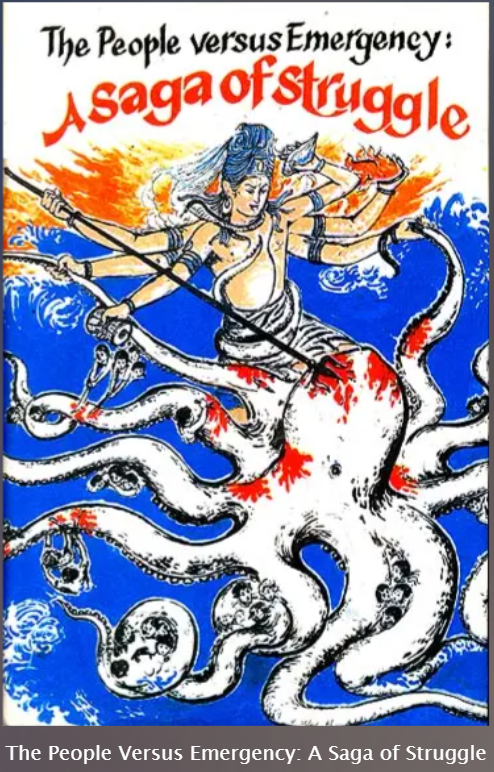
- “The People Versus Emergency – A saga of Struggle” by P.G. Sahasrabuddhe, Manik Chandra Vajpayee (English rendering by Sudhakar Raje) — Suruchi Prakashan, Keshav Kunj, New Delhi.

3. Emergency in India, When Congress Crushed Democracy and Contribution of RSS in Restoring it
4. The RSS And Emergency – by Virag Pochpore, Nagpur based Journalist
5. Janata Couldn’t Have Won Without RSS – (by Surajit Dasgupta)
6. Emergency Supporters: A List That Will Surprise You
9. Three Heroes of Emergency
10. The Emergency Revisited – Part – I (3-Part Series)
11. Media Watch : Recalling The Dark Days Of Emergency
12. National Interests, Remembering Black Deeds Of Emergency


 Arise Bharat
Leave a comment