
By Salma Mahmud
The Friday Times – 2013
The aplomb with which the great grammarian Panini met his gory death at the hands of a ferocious lion is a lesson to us all. That ancient collection of animal fables, the Panchatantra, c. 3rd century BC, mentions his death as an accepted fact.
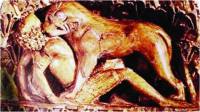
Panini was teaching grammar to his pupils in his forest ashram in Taxila, when a roaring lion came bounding up to them. He asked his pupils to listen to the lion’s roaring and try to work out its grammatical form. The lion is poised, ready to pounce, the pupils are trembling with fear, and Panini works out the grammatical form of the roar. It is said that even when the lion fell upon him he continued to explain the grammatical form of its roaring. And as the lion devoured him he expounded on the grammatical form of ‘The lion kills the man.’
The 6th century BC was an eventful era. It was the time when Panini composed the oldest available grammar of any language (Sanskrit in this case) and when the Neo-Babylonian Empire in the Near East was overthrown by Cyrus, who founded the Persian Empire in its place. It was in this very century that Zoroaster founded Zoroastrianism. In India the Buddha and Mahavira founded Buddhism and Jainism respectively, and the occupation of the Punjab was completed by the Persian King Vistaspa, making it a part of the greater Gandharan Empire, while in faraway China Confucianism and Taoism flourished.
Panini was born in Salatura, a small town identified with the ancient and original Lahur (not to be confused with Lahore, Punjab’s capital) situated on the banks of the River Indus. Alexander the Great is said to have passed through this area when he arrived in the Potohar district, and it was a part of the Hindu Shahiya kingdom of Ohind. Sir Alexander Cunningham, the founder of the Archeological Survey of India, and a renowned expert on Buddhist stupas, identified Salatura as Panini’s birthplace. Scholars disagree to a certain extent as to whether to call it Salatura or Lahur, but Panini states firmly at the beginning of Ashtadhyayi that he was born in Salatura, an area that has always produced warriors of the finest order.
He had one known sibling, Pingala, who was a brilliant mathematician and a master of prosody. Believe it or not, he was killed by a crocodile! No one can say that the two brilliant sons of Shalanka and his wife Dakshi were not disaster-prone.
Panini’s Ashtadhyayi formulated 3,959 rules of Classical Sanskrit morphology, syntax and semantics, and in its 8 chapters it was the grammatical branch of the Vedanga, the auxiliary scholarly branch of Vedic religion. It is the earliest known work on descriptive linguistics, and together with the work of his immediate predecesors, stands at the beginning of the history of linguistics itself. His theory of morphological analysis was more advanced than any equivalent Western theory before the mid 20th century. His analysis of noun compounds still forms the basis of modern linguistic theories of compounding, which have borrowed certain key Sanskrit terms from him.
Panini’s work is of a brevity and completeness unmatched in any ancient grammar of any language, and is highly systematic and technical. His immensely sophisticated logical rules and techniques have been widely influential in ancient and modern linguistics. His reputation many centuries after his death can be ascertained by the fact that Hieun Tsang, the Chinese scholar-monk who visited India in the 7th century AD, mentions seeing a huge statue of Panini at his place of birth. He also writes that Panini dedicated his great work to his king, who highly appreciated it and announced a prize of one thousand gold coins to anyone who could recite the entire book. This might give an indication of the kinds of gifts that the king would have given to Panini himself. Unfortunately, Hieun Tsang did not name the king who reigned during Panini’s lifetime. And today we find no takers for a fresh statue of our great ancestor being put up in his place of birth.
He should be thought of as the forerunner of the modern language theory used to specify computer languages. The Backus Normal Form was discovered independently by John Backus in 1959, but Panini’s notation is equivalent in its power to that of Backus and has many similar properties. It is indeed remarkable that concepts that are fundamental to today’s theoretical computer science should have their origin with this Indian genius. In fact algebraic reasoning, the Indian way of representing numbers by words, and ultimately the development of modern number systems in India, are linked through the structure of language.
An equally intriguing personality was Panini’s younger brother Pingala, a devotee of Surya, the god of the sun. His Chandas Shastra is a work of 8 chapters, which survives only in fragments and is the earliest known treatise on Sanskrit prosody.
John Eskanazi, one of the world’s best-known dealers in Indian and Gandharan art, exhibits in his London gallery a striking beige sandstone figure of Pingala, 43 cm high, dressed in the costume of a Sassanian dignitary. He holds a pen and paper in his hands, as befits a master of prosody. Images from Mathura depict him as one of two diminutive attendants of Surya. His appearance in the large statue shows us a man with piercing eyes and a pointed nose, and with a thoughtful expression on his face; an imposing figure indeed. There were artists who cared enough to depict him in sandstone, and so he lives on. There are even some images of Surya that show him wearing crocodile earrings…
Pingala’s treatise is at the transition between Vedic metre and the classic metre of the Sanskrit epics, Sanskrit being a language of great expressivenes and melody, and one can imagine Pingala himself composing verses in the language of which he was such an expert. Maharishi Mahesh Yogi did not care to describe Pingala’s end, but his admirers might posit a believable scenario. He could perhaps be imagined as reclining on the shores of a sparkling stream near the monasteries of Taxila, humming the opening lines to a hymn in honour of Surya… ‘You are without origin, middle or end. I see you with blazing fire coming forth from your mouth, burning this entire universe by your own radiance…’ And then snap, the wicked jaws of a Mugger that had waddled out from the water closes upon this great master!
His Chandas Shastra presents the first known description of a binary numeral system, connected with the systematic enumeration of metres with fixed short and long syllables. His work anticipates the 17th century French mathematician Blaise Pascal’s Triangle as well as containing the fabulous Italian Leonardo Fibonacci’s “golden numbers”. (Fibonacci spread the Hindu-Arabic system of numbers throughout Europe in the Middle Ages.)
To ask ourselves whether we are capable of paying homage to such greatness is perhaps futile, but at least we could refrain from supporting what is going on in Taxila these days, and perhaps speak out against it.
The future of public access to the grand Unesco-listed Dharmarajika Stupa, built by Ashoka the Great in the 3rd century BC, is threatened by private construction. It is a victim of a dispute between the Department of Archaeology and a property owner. The stupa is surrounded by military installations and army residential quarters; a private orchard nearby has been developed by a brigadier, who has constructed a wall and a gate around it, which block the only entrance to this World Heritage site. A house has already been built within the confines of the wall. Less than a month ago, the signpost directing visitors to the site was ripped out of the ground and tossed contemptuously across the road. The Department of Archaeology is considering going to court over the matter.
We are heirs to greatness. But we do nothing when this greatness is destroyed in the most wanton fashion.
Read more:



 Arise Bharat
Leave a comment