
By: Kuldeep Jha
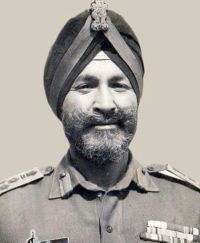
Major General Shabeg Singh was one of the Indian Army’s most distinguished officers, a hero of the 1971 Bangladesh Liberation War whose career was tragically derailed by Prime Minister Indira Gandhi’s tendency to leverage the military to suppress internal political dissent.
His principled refusal to deploy troops against the Jayaprakash Narayan (JP) Movement in the mid-1970s led to his controversial dismissal from the army, a punitive act that transformed a decorated Sikh officer into a figure of rebellion.
A Distinguished Military Record
Born in 1924 in Khiala village near Amritsar, Punjab, Shabeg Singh hailed from a Bhangu Jat Sikh family. He joined the Indian Army during World War II and served with distinction in the 1947 Indo-Pak War, the 1962 Sino-Indian War, and the 1965 Indo-Pak War. His most notable contribution came during the 1971 Bangladesh Liberation War, where, as a colonel, he trained the Mukti Bahini guerrillas, playing a critical role in India’s victory over Pakistan.
For his strategic brilliance, Singh was awarded the Param Vishisht Seva Medal (PVSM) and Ati Vishisht Seva Medal (AVSM).
By 1972, he had risen to the rank of Major General and was appointed General Officer Commanding (GOC) of the Madhya Bharat Area, overseeing Madhya Pradesh, Bihar, and Orissa—a role that underscored his reputation as a disciplined and capable leader.
The JP Movement and Political Overreach
The early 1970s marked a period of growing unrest in India. Indira Gandhi, despite her triumph in the 1971 war, faced mounting criticism over economic challenges and corruption within her Congress government.
The JP Movement, led by freedom fighter Jayaprakash Narayan, emerged in Bihar around 1973 as a powerful anti-corruption campaign, advocating “Total Revolution” to overhaul India’s political system. By 1974–75, the movement had gained widespread support from students, intellectuals, and opposition parties, posing a significant challenge to Gandhi’s authority.
As the protests escalated, the government struggled to maintain order, particularly in Bihar, where local police were reportedly reluctant to crack down on Narayan’s supporters.
In a highly controversial move, Gandhi’s administration considered deploying the Indian Army to suppress the movement and arrest Narayan—a decision that violated the military’s tradition of remaining apolitical.
As GOC of the Madhya Bharat Area, Shabeg Singh was allegedly ordered to mobilize troops to detain Narayan and quell the protests. Steadfast in his belief that the army should not be used as a tool of political repression, Singh refused to comply, arguing that such actions undermined the democratic principles he had sworn to uphold.
A Punitive Dismissal
General Singh’s defiance came at a steep cost. In June 1975, Indira Gandhi declared a state of Emergency, ushering in a period of authoritarian rule marked by the suspension of civil liberties and suppression of dissent.
Singh was promptly transferred from his command to a less significant role at the area headquarters in Bareilly, Uttar Pradesh. On April 30, 1976, just one day before his scheduled retirement, he was dismissed from the Indian Army without a court-martial—an extraordinary measure executed under a rare administrative clause, reportedly never used before in the Indian Army.
The charges against Singh were dubious: purchasing a Jonga military vehicle on proxy and constructing a house valued at Rs. 9 lakhs, which he claimed was worth Rs. 1.75 lakhs.
The Central Bureau of Investigation (CBI) pursued the case, filing two charge sheets in an anti-corruption court in Lucknow. The timing of the dismissal, the absence of a court-martial, and the nature of the allegations strongly suggest a politically motivated act of retribution.
Singh maintained that his sacking was a direct consequence of his refusal to act against the JP Movement, possibly exacerbated by his Sikh identity amid rising political tensions in Punjab. The dismissal stripped him of his rank, denied him his full pension, and subjected him to profound humiliation—a devastating blow to a man who had devoted his life to serving India.
Politicizing the Military
Indira Gandhi’s willingness to involve the army in internal politics was part of a broader pattern during the Emergency (1975–77). The government’s blurring of lines between military and civilian roles undermined the army’s independence, creating tensions with officers who valued its apolitical ethos.
The sidelining of Field Marshal Sam Manekshaw, another military luminary, after the 1971 war highlighted Gandhi’s unease with strong military figures who might resist political directives.
In Singh’s case, the use of an obscure administrative clause to dismiss him without due process was particularly egregious, signaling that defiance, even on principled grounds, would be met with severe consequences.
The CBI’s prolonged investigation and the flimsiness of the charges further indicate an intent to tarnish Singh’s reputation rather than deliver justice.
On February 13, 1984, the Supreme Court of India acquitted Singh of all charges, confirming that the accusations were baseless. However, the acquittal came after years of legal battles and personal hardship, too late to restore his career or mitigate the sense of betrayal that had taken root.
A Hero’s Descent
The injustice of his dismissal profoundly altered General Singh’s trajectory. Feeling wronged by the nation he had served, he joined the Sikh movement for rights in Punjab, known as the Dharam Yudh Morcha, led by Jarnail Singh Bhindranwale. In March 1984, Bhindranwale summoned Singh to Amritsar, where he became his military adviser.
Leveraging his expertise, General Singh fortified the Golden Temple complex, preparing defenses that would pose a significant challenge to the Indian Army during Operation Blue Star in June 1984.
In an interview with The Telegraph on May 16, 1984, Singh articulated that his actions were driven by a desire to redress the humiliation inflicted by the government, rather than a commitment to separatist ideals.
During Operation Blue Star, General Singh was killed by a sniper on June 5, 1984, in the basement of the Akal Takht. His body was discovered the following day, and he was cremated with full Sikh rites and military honors, a poignant acknowledgment of his earlier contributions.
His death marked the tragic conclusion of a career that had once embodied valor and service. Indira Gandhi’s readiness to deploy the army against the JP Movement and her administration’s vindictive response to General Singh’s refusal violated the principles of military neutrality, alienating a loyal officer whose only fault was his commitment to democratic ideals


 Arise Bharat
Leave a comment