
- – Ayyappa G & Santhosh A.S
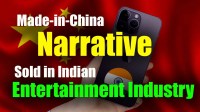
Recently, a Telugu YouTuber who made a positive video about China openly said that he earned thirty lakhs in one month. Remember the news that the earlier Aamir Khan starrer ‘PK’ collected 1500 crores in China? It is no big surprise that fake views and fake collections are coming with the money pouring in from China. China’s real objective is to leverage Chinese entities and Chinese companies operating in India to extract profits and influence the opinion of the Indian people against the Indian government especially with regard to border disputes.
China’s sinister designs to influence various segments in India have been brought out in a report prepared by the Law and Society Alliance, released on the 3rd of September 2021. The 76-page study report enumerates the covert and overt influence operations carried out by the Communist Party of China (CCP), led by Xi Jinping, in cultivating, funding, and sponsoring institutions including the media and individual opinion-makers. The report concluded that China’s efforts to penetrate Indian society through various means such as financial investments, student fellowships and tourist travel arrangements for those who act in their favor will be very harmful in the long run. China has already made inroads into the Indian entertainment industry, and now its focus is squarely on think tanks and educational institutions, the report states.
According to the report, a newly established organization in Delhi is actively working to create pro-China sentiments among Indians and is performing its duties with the same status as a Chinese embassy. People selected by this organization are sent to China in the name of ‘education’, trade or tourism. After adequate ‘training’ there, they will work to spread sentiments favourable to the Chinese government and the Chinese Communist Party in India.
If we go back 20 years, say by 2000, America was a superpower and there was a continuous effort by the Chinese Communist Party’s media management teams behind the emergence of China as a dominant power in the financial, commercial, and arms sectors by ending America’s monopoly. In the beginning, Hollywood films were indirectly funded and scripts were created to star Chinese characters with heroes like Jackie Chan and Jet Lee as the main theme. Through many hit movies like Shanghai Noon and Rush Hour, American capitalists erased the negative view of Communist China and indirectly planted the concept of America-China Bhai Bhai.
In Rajinikanth’s 2002 film titled ‘Baba’, a character of a Tribal astrologer shows his phone with the dialogue “It’s Made in China, with touch screen”. Don’t know whether it is a paid promotion, but that scene creates an opinion that Chinese phones are low-quality, inexpensive and are used by the people of mass sections. Mobile giants such as Nokia, BlackBerry and Motorola were the only popular brands at that time. Later Motorola was taken over by Lenovo, a Chinese company and in big-budget Hollywood movies the main characters are shown using Chinese-brand laptops and electronic gadgets like Lenovo. This is the promotion inherent in movies. In addition to this, former US President Obama opened the door to America’s outsourcing program during his administration and indirectly contributed to China’s reverse engineering and copyright and design thefts. As a result, ten years later, China’s dominance began in the entire manufacturing sector, including mobile phones, and electronic gadgets, including the iPhone. Obama can be described as Manmohan Singh of America.
Now it is India’s turn to be subjected to Chinese manipulation of Indian public opinion. After Xi Jinping became China’s president in 2013, he ordered Chinese media outlets to “promote China in a big way around the world”. As there was not much influence of social media in India, pro-Chinese content started appearing in newspapers like The Hindu and web portals like The Print, Scroll, and The Wire. By the time of Doklam conflict, internet usage and social media had grown substantially across India and ‘Boycott China’ movement gained momentum. As a result of this, peddlers of Chinese propaganda China Bazaars in India had to change their boards and give other names like Bombay Bazaar. Chinese manufacturing companies have also come to the misfortune of selling their products with labels ‘Made in PRC’ instead of ‘Made in China’. In the history of world trade, no country has done business under such a fake name.
In recent years, incidents such as the military clash at Pangong Lake and the death of Indian soldiers, the registration of cases against Chinese mobile companies Oppo and Vivo for economic offences, and the ban on Tik Tok & Chinese loan apps have greatly increased the opposition to China amongst the Indian people. Naturally, the negative image regarding China amongst Indian citizens directly impacted the Indian Communist parties and their credibility was eroded and their political influence also declined. At the same time, as a survey said that Indian Prime Minister Narendra Modi has 50 crore fans in China, Chinese government forcibly deleted sixteen lakh pro-India posts on social media platforms like Weibo.
Now to top it all off, it must be said that moving the iPhone and Foxconn manufacturing unit from China to India is a huge setback for Chinese Government. After this, Chinese media management started implementing new strategies. As the influence of print media has decreased, thousands of pages in Indian languages are being published directly from China on social media platforms. There are thousands of YouTube channels chronicling China’s achievements. Recently, a Telugu YouTuber who made a series of positive videos about China openly revealed that he earned thirty lakhs in a month for his Chinese episodes. Remember the news that earlier Aamir Khan starrer PK collected 1500 crores in China? It is no big surprise that fake views and fake collections are coming with the money pouring in from China. China’s real aim is to strengthen the Communist parties and Chinese companies in India and reap profits, and to influence the opinion of the Indian people against the Indian government during border disputes. If this continues, there is a danger that the game played by China in America twenty years ago will be repeated in India’s social media.




 Arise Bharat
Leave a comment