
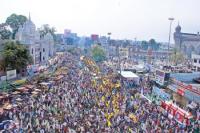
The birthday of Prophet Mohammed is traditionally celebrated on the 12 th day in the month of Rabiʽ al-Awwal as per Islamic calendar. It is also known as Mawlid. The celebrations are used by Muslims across the world to come closer to Allah and his messenger, Prophet Mohammed and the teachings of Islam. The day is marked by great enthusiasm, happiness and colourful lighting of homes and Islamic shrines, In India, the celebrations are marked by processions taken out by Muslims.
According to Islamic scholars, there is nothing in the Quran to say that we should celebrate the Mawlid al-Nabi or birthday of the Prophet Muhammad (peace and blessings be upon him). The Prophet himself did not do this or command anyone to do it, either during his lifetime or after his death. The first ones to introduce (celebration of the Mawlid) in Cairo were the Faatimid caliphs in the fourth century AH. They introduced the celebration of six birthdays: the Prophet’s birthday, the birthday of Imam ‘Ali (may Allah be pleased with him), the birthday of Faatimah az-Zahra’ (may Allah be pleased with her), the birthdays of al-Hasan and al-Husayn (may Allah be pleased with them), and the birthday of the current caliph. These celebrations continued to be observed until they were abolished by al-Afdal, the commander of the army. Then they were restored during the caliphate of al-Aamir bi-Ahkaam Allah in 524 AH, after the people had almost forgotten about them. The first one to introduce celebration of the Prophet’s birthday in the city of Irbil was al-Malik al-Muzaffar Abu Sa‘eed in the seventh century.
As Milad-un-Nabi is a practice rather than a command ordained in Quran, a section of the Muslims particularly those from the Wahabbi sect do not celebrate the same as they consider it an innovation (Biddah) which is not permitted in Islam. Wahhabism advocates a purification of Islam, rejects Islamic theology and philosophy developed after the death of the Prophet Muhammad, and calls for strict adherence to the letter of the Koran and hadith (the recorded sayings and practices of the Prophet). In Saudi Arabia where Islam originated and contains the most important Haj pilgrimage city of Mecca, Milad-un-Nabi is not celebrated. It is not officially recognized or celebrated in Saudi Arabia.
In India, contemporary Ulema of Deoband have declared it an innovation (bid’ah). Their objection to the celebration of Milad-un-Nabi is as follows:
“It is clear from the above that we do not reject the mentioning of the Messenger of Allah’s (Allah bless him & give him peace) birth; rather, we reject and refute those evils that are attached to such gatherings as you may have seen them in the Indian subcontinent, such as mentioning fabricated and false narrations, intermingling of the sexes, excessive wasteful spending with lights and decorations, holding it to be something necessary to do such that those who choose not to anticipate are slandered and called non-believers, and other evils from which very few gatherings (in the subcontinent) are free. However, if the gathering is free from such evils, far be it from us that we say, mentioning the birth of the Messenger of Allah (Allah bless him & give him peace) is an evil and innovation…” Thus the objections of scholars from Deoband school of Islam to celebrations of Milad-un-Nabi are due to the following ‘evils’ which have crept into the celebration of the festival.
1) A particular date (12 of Rabi al-Awwal) has been designated for this remembrance,
2) The element of show-off (riya) is commonly present in these gatherings,
3) If someone does not attend these gatherings, he is looked down upon,
4) Distribution of sweets is considered an indispensable part of the proceedings,
5) To meet the expenses, donations are collected from sometimes unwilling people who give money under social pressure. According to the hadith it is not permissible to take any Muslim’s money without his willingness.
6) Intermixing of men and women commonly takes place in these gatherings. People stay late at night in these meetings thereby missing the next morning’s prayers.
7) The focus of the talks delivered there is very limited. They do not attempt to cover the vast teachings
of the Prophet( SAWS)
Another view regarding the celebration of Milad-un-Nabi is the difference amongst Islamic scholars regarding the exact date of birth of Prophet Mohammed(SAWS). Some scholars opine that the Prophet was born on 8th , 10th in the month of Rabiʽ al-Awwal while others opine that he was born in the month of Ramzan.
This difference of opinion among the scholars is sufficient for us to realise that those who loved the Prophet (blessings and peace of Allah be upon him) among the early generations of this ummah were not certain about the date of his birth, let alone celebrating it. Several centuries passed during which the Muslims did not celebrate his birthday, until it was introduced by the Faatimids.
Barelvis – a major sect of Islam in India, consider Milad-un-Nabi celebrations as a recommended act. Their view is that so long as a recommended act does not obstruct obligatory acts, it should be followed. In other words, obligatory prayers should not be neglected in the enthusiasm to celebrate Milad-un- Nabi.
Zakir Naik, a popular but controversial Islamic scholar also questioned the Milad-un-Nabi celebrations. He said that celebrating birthdays is a Western culture and that 12 Rabiʽ al-Awwal happens to be both the birthday and date of death of Prophet Mohammed. As such what is being celebrated – birthday or death anniversary?
In conclusion, we can say that despite differing views, Milad-un-Nabi celebrations have caught on in a big way across the Muslim community and the occasion is declared a holiday in many countries (except Saudi Arabia and Qatar).
By Sahadev K
The author is senior associate at Centre for South Indian Studies (CSIS)

 Arise Bharat
Leave a comment