
Col Ajay Singh ( retd )
The Ghost of Henry Kissinger
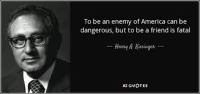
Henry Kissinger’s much-quoted warning, “It may be dangerous to be America’s enemy, but to be America’s friend is fatal,”* has become a shorthand for what many see as the unreliability of US alliances. The phrase, often stripped of its original context, portrays the US as a power that utilises partners for short-term purposes and discards them when they no longer serve its interests. The record of US alliances from South Vietnam to the Shah of Iran shows how often this pattern has played out.
Donald Trump’s sudden warmth towards Pakistan raises the question: is Islamabad walking into the same trap? Historical precedent suggests that a highly personalised alliance, based on immediate gains rather than shared strategy, is inherently risky.
The Real Story Behind the Quote
Kissinger’s warning was not moral outrage but a strategic point. In his realist worldview, reliability was a tool of statecraft, not a virtue for its own sake. If allies doubted US resolve, the balance of power would suffer. Ironically, his own career and later US policies gave adversaries plenty of material to argue the opposite, that America’s friendships come with an expiry date.
Countries such as South Vietnam, Iran under the Shah, and the Kurds have lived through this cycle. Their fate has given Kissinger’s private warning a life far beyond its original meaning.
When Friends Fell: South Vietnam
The fall of South Vietnam in 1975 is a textbook case. The Paris Peace Accords in 1973 were sold in Washington as “peace with honor,” but they marked the start of a quiet disengagement. US combat troops left, and within two years Congress cut military aid, despite repeated presidential promises to stand by Saigon.
Deprived of funds and supplies, the South Vietnamese army’s morale collapsed. When North Vietnam launched its final offensive, Saigon fell in weeks. The desperate scenes of evacuation, helicopters lifting from rooftops, allies left behind, became an enduring symbol of what “fatal friendship” can look like.
The Shah of Iran’s Collapse
In Iran, the Shah’s regime had been restored and propped up by the US since the 1953 CIA-backed coup. American military and financial support kept flowing, over $16 billion in arms sales between 1972 and 1977, but it also tied the Shah’s increasingly autocratic rule directly to Washington.
When domestic unrest exploded in 1978, US intelligence failed to see the scale of the crisis. The Shah’s close identification with America made him a lightning rod for revolutionary anger. The 1979 Islamic Revolution not only swept him from power but brought in a regime openly hostile to the US, a long-term strategic loss for Washington.
The Kurds: Betrayal as a Recurring Pattern
No ally has been more repeatedly let down than the Kurds. In the 1970s, US covert aid to Kurdish rebels in Iraq ended abruptly after a deal between Washington, Tehran, and Baghdad. Kissinger himself brushed off the criticism, saying covert action “should not be confused with missionary work.”
The same pattern recurred after the Gulf War in 1991, after the fight against ISIS in Syria, and during the 2017 Iraqi Kurdistan independence referendum. Each time, Kurdish forces served as effective partners, only to be left exposed once US priorities changed.
Other Cautionary Tales
History offers more examples.
- Afghanistan (2021): After two decades of war, the US withdrew, leaving the Afghan government and military to collapse within days.
- Egypt (2013): Long backed by Washington, President Hosni Mubarak’s fall during the Arab Spring exposed the limits of US protection for long-standing partners.
- Somalia (1993): The sudden US exit after the “Black Hawk Down” incident left Somali factions and partners abandoned to chaos.
These cases feed the perception that the US will leave when the domestic political cost gets too high, regardless of promises made abroad.
Trump’s Pakistan Turn
Trump’s pivot towards Pakistan is a sharp reversal from his earlier accusations that Islamabad offered “nothing but lies and deceit” while taking billions in aid. Today, the warmth is expressed through oil trade deals, promises to help develop “massive oil reserves,” and even a controversial blockchain agreement with a company linked to Trump’s family.
This courtship has an unmistakably personal stamp. Pakistan’s nomination of Trump for the 2026 Nobel Peace Prize, citing his role in easing tensions with India, fits neatly into his taste for high-profile flattery. High-level meetings with Pakistan’s army chief bypass much of the civilian leadership, reinforcing the military’s political dominance.
Strategically, the US has rewarded Pakistan by designating the Balochistan Liberation Army as a terrorist group, a move welcomed in Rawalpindi and linked to Pakistan’s cooperation on extraditing suspects wanted in the US. Economic and security exchanges have been transactional, tied directly to short-term gains rather than to any sustained vision for regional stability.
The Military Channel
Much of this outreach bypasses Pakistan’s civilian government. Trump’s repeated meetings with Army Chief General Asim Munir and the designation of the Balochistan Liberation Army as a terrorist group signal a tilt toward the military as the main channel for engagement.
While this may produce short-term gains for both sides, it risks reinforcing Pakistan’s military dominance in politics and undermining civilian institutions, a pattern that has historically destabilised the country.
India’s Uneasy View
The timing of this US-Pakistan revival could not be worse for India. In May 2025, after a terrorist attack in Pahalgam, India and Pakistan fought a brief but intense conflict involving missile and drone strikes deep into each other’s territory.
Trump claimed credit for mediating a ceasefire, but India publicly denied any US role, insisting it negotiated directly with Pakistan. For New Delhi, accepting Trump’s claim would undermine its long-standing policy of rejecting third-party mediation.
This dispute over “who made peace” has added to friction already created by US tariffs on Indian goods, sanctions over Russian oil imports, and public praise for Pakistan’s military. It threatens decades of careful US-India relationship building, which has been central to Washington’s Indo-Pacific strategy.
A Fragile and Risky Arrangement
Pakistan’s new closeness with Washington under Trump is fragile. It is built around personal rapport, narrow economic deals, and military cooperation rather than broad institutional or bipartisan support. History shows that such arrangements are the easiest to reverse.
If a future US administration — or even Trump himself — decides Pakistan is no longer useful, the relationship could unravel quickly, leaving Islamabad exposed. That is precisely the danger Kissinger’s warning hinted at: the risk of being caught in America’s shifting priorities without the ability to shape them.
Strategic Costs for Washington
Trump’s tilt towards Pakistan, at the expense of India, comes at a time when Washington needs New Delhi to balance China in the Indo-Pacific. The risk is that India could drift towards other partners, accelerating its push for a multi-polar world where it is less reliant on the US.
By disrupting the careful balance past administrations maintained between India and Pakistan, Trump risks undermining a key pillar of US strategy in Asia. This approach may satisfy short-term political goals, but it carries long-term costs that go beyond South Asia.
Lessons from History
Kissinger’s original comment was about a single ally in a single moment, but its afterlife reflects a recurring truth in US statecraft. South Vietnam, Iran, the Kurds, Afghanistan, and others show how easily allies can be left behind when domestic politics or strategic interests change.
Pakistan today enjoys rare public affection from a US president, but the embrace is built on sand. It is personal, not institutional; transactional, not strategic. That combination has been the undoing of many US partners before. If history is a guide, Pakistan’s current moment in Washington’s spotlight could be the prelude to a sharp and painful fall , proving yet again that being America’s friend can be, in the long run, dangerous.
- “Word should be gotten to Nixon that if Thieu meets the same fate as Diem, the word will go out to the nations of the world that it may be dangerous to be America’s enemy, but to be America’s friend is fatal.”
Sources: Kissinger’s War, 1957-1975 and United Nations Journal: A Delegate’s Odyssey
Kissinger said this in late November 1968 after Nixon was elected president, but before Nixon was inaugurated.
It wasn’t a public statement, just a statement to William F. Buckley Jr. in a phone call, with Buckley taking notes, so it isn’t verifiable beyond Buckley (author of United Nations Journal: A Delegate’s Odyssey).

 Arise Bharat
Leave a comment