
Author : Col. Ajay Kumar ( retd )
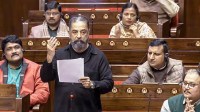
When a cultural icon enters Parliament, expectations naturally extend beyond eloquence and public charm. A maiden speech in the Rajya Sabha is not merely a ceremonial transition; it is a test of intellectual depth, ideological coherence, and constitutional responsibility. On 4 February 2026, actor-turned-politician Kamal Haasan delivered his first parliamentary address. It was widely praised for its diction and composure. Yet, beneath its polished surface, the speech revealed unresolved contradictions between performance and principle, exposing gaps in Haasan’s political vision and his understanding of Bharat’s civilisational foundations.
Linguistic Contradictions: English Eloquence and Tamil Identity
One of the most striking features of Haasan’s speech was his reliance on sophisticated English to articulate concerns rooted in Tamil identity. In a speech that emphasised regional pride and cultural dignity, the dominant language was not Tamil but a refined, elite register of English. This contradiction cannot be dismissed as incidental. Language reflects political positioning. When a leader claims deep emotional attachment to Tamil but chooses English as the primary vehicle of expression in Parliament, it raises serious questions about sincerity and priorities.
If Tamil is central to political identity, it must occupy a central place in political practice. Speaking in English while invoking linguistic pride transforms Tamil into a symbolic tool rather than a living instrument of governance. It reinforces a hierarchy in which English remains the language of authority and Tamil becomes a sentimental accessory. Such an approach weakens the moral force of linguistic advocacy.
Haasan’s earlier public remarks on linguistic origins, particularly his assertion that Kannada emerged from Tamil, also reveal a tendency to frame language in competitive or hierarchical terms. Instead of promoting mutual respect among Bharatiya languages, such statements encourage unnecessary divisions. Linguistic heritage should be a source of shared enrichment, not political rivalry.
Periyar and the Question of Civilisational Respect
Haasan’s acknowledgment of Periyar E.V. Ramasamy as a major intellectual influence demands serious reflection. Periyar’s role in challenging caste hierarchies and social stagnation is well known. However, his methods and rhetoric were frequently grounded in open hostility toward Sanatana traditions, religious symbols, and spiritual institutions that have shaped Bharatiya society for centuries.
Public desecration of religious icons, dismissal of sacred texts, and contemptuous portrayals of Hindu traditions were central features of Periyar’s activism. These actions were not limited to social reform; they represented a sustained assault on civilisational continuity. By invoking Periyar as a source of “logic,” Haasan implicitly aligns himself with a legacy that often treated faith and tradition as obstacles rather than as components of Bharat’s plural social fabric.
This alignment becomes more troubling in light of recent statements by prominent DMK leaders calling for the “eradication” of Sanatana Dharma. Such language, regardless of intent, reflects a disturbing intolerance toward belief systems followed by millions of citizens. When Haasan associates himself with this ideological lineage, he signals a disregard for the spiritual foundations that have sustained Bharat’s cultural unity.
A national legislator must operate within a framework of mutual respect among communities. Reform does not require rejection of civilisational heritage. Progress does not demand contempt for tradition. Political critique must be anchored in constitutional pluralism, not in ideological hostility.
Colonial Origins of the North–South Divide
The idea of an inherent and permanent divide between North and South Bharat has its roots in nineteenth-century colonial scholarship. British missionaries and administrators, most notably Robert Caldwell, classified Bharatiya languages into “Aryan” and “Dravidian” families and gradually transformed linguistic distinctions into racial and political categories.
These classifications were not neutral academic exercises. They served colonial interests by fragmenting Bharatiya society and weakening collective identity. Over time, these constructs were absorbed into regional politics and repackaged as ideological tools. Dravidian exceptionalism emerged from this intellectual environment, presenting Southern Bharat as fundamentally distinct from the rest of the country.
Modern scholarship recognises linguistic families without equating them with racial or civilisational separation. Language differences do not imply separate destinies. Yet Haasan’s rhetoric continues to operate within this colonial framework, treating “Dravidian” identity as a political counterweight to Bharatiya unity.
Bharat’s history demonstrates continuous cultural exchange across regions. Philosophy, art, trade, and spiritual traditions flowed freely between North and South for centuries. The attempt to freeze these relationships into rigid categories reflects colonial thinking, not indigenous reality.
Regional Pride and Constitutional Responsibility
Federalism in Bharat exists to protect diversity, not to institutionalise fragmentation. The Constitution balances state autonomy with national unity. It recognises linguistic and cultural plurality while affirming shared citizenship.
Haasan’s emphasis on Tamil exceptionalism risks weakening this balance. By framing Tamil identity as perpetually threatened and structurally distinct, he encourages a binary between “Tamil” and “Bharatiya.” This binary ignores the layered identities of citizens who are simultaneously rooted in their regions and committed to the republic.
Tamil culture flourished long before colonial rule and will continue to flourish within a unified Bharat. It does not require political isolation to survive. It requires confidence, openness, and institutional support.
Cinema, Gender, and Unfulfilled Responsibility
Haasan frequently invokes his long career in cinema as evidence of social awareness. He speaks about gender bias and unequal opportunities in the film industry. Yet these statements are not matched by sustained institutional reform under his leadership.
Despite his influence as an actor, producer, and studio owner, the Tamil film industry remains characterised by large pay gaps, limited opportunities for women directors, and structural barriers to female leadership. His own production ventures have not produced a systematic shift in these patterns.
If Haasan truly believes in gender equality, that belief must be reflected in hiring practices, remuneration policies, mentorship programmes, and transparent industry standards. Occasional public statements do not substitute for structural change.
Invoking cinema as moral capital without translating it into institutional reform weakens the credibility of political advocacy.
Electoral Integrity and Selective Vigilance
In his Rajya Sabha speech, Haasan raised concerns about electoral roll revisions and their impact on voting rights. Safeguarding electoral participation is essential in any democracy. Administrative processes must be transparent, inclusive, and accountable.
However, democratic integrity cannot be defended selectively. Tamil Nadu’s political landscape has long been shaped by heavy campaign spending, vote-buying allegations, and entrenched patronage networks. Regional parties have often benefited from these practices.
Addressing only national-level risks while remaining silent on local distortions reflects selective vigilance. A consistent commitment to democracy requires confronting all forms of electoral manipulation, regardless of political convenience.
Subramania Bharati and an Alternative Tamil Nationalism
A more constructive model of Tamil political consciousness is found in the life and work of Subramania Bharati. Bharati embodied linguistic pride without regional isolation. He mastered multiple languages, engaged deeply with North Bharatiya intellectual traditions, and envisioned Bharat as a unified civilisational space enriched by diversity.
His poetry celebrated Tamil culture while embracing pan-Bharatiya solidarity. He viewed Hindi, Sanskrit, and other Bharatiya languages as bridges, not threats. For Bharati, cultural confidence enabled openness; it did not produce defensiveness.
This vision contrasts sharply with contemporary regionalism that relies on grievance and separation. Bharati demonstrated that one can be deeply Tamil and profoundly Bharatiya without contradiction.
Conclusion: Style Without Substance
Kamal Haasan’s maiden parliamentary speech displayed polish, discipline, and theatrical finesse. Yet politics demands more than presentation. It demands intellectual honesty, historical awareness, and institutional commitment.
His reliance on English while professing Tamil devotion, his alignment with ideologies hostile to civilizational traditions, his acceptance of colonial identity frameworks, his limited record on industry reform, and his selective approach to democratic accountability collectively reveal a politics of performance rather than transformation.
Bharat does not need eloquence detached from responsibility. It needs leaders who can integrate regional pride with constitutional unity, social reform with cultural respect, and rhetoric with institutional action.
Until Kamal Haasan bridges this gap between words and substance, his parliamentary presence will remain impressive in form but inadequate in purpose.



 Arise Bharat
Leave a comment