
Author : Lt Col Ajay Kumar (retd)
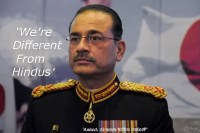
By invoking the failed Two-Nation Theory and projecting religious supremacy over “Hindu” India, Pakistan Army Chief General Asim Munir has openly declared that Pakistan is not just an Islamic republic in name but an ideological garrison state in purpose. His recent hardline speech, reeking of religious chauvinism and militaristic arrogance, is not a routine expression of strategic bravado—it is a terrifying reflection of Pakistan’s descent into totalitarianism cloaked in Islamic militarism.
More than targeting India, Munir’s speech was aimed at Pakistan’s own people—Balochs, Pashtuns, Shias, Ahmadis, and Hindus—labelled as traitors, kafirs, or enemies simply for asserting their identity and rights. The General’s words are not just divisive—they are genocidal in intent, echoing the brutal mindset that led to the massacre of millions in East Pakistan in 1971.
The Audience Within
By invoking the two-nation theory and urging the diaspora to “narrate how the nation was born” to their children, Munir sought to reinforce a singular, exclusionary national identity rooted in religious difference. This message was as much for domestic consolidation as it was for the diaspora: a call to close ranks, suppress dissent, and internalise a siege mentality in the face of mounting separatist pressures, especially in Balochistan.
When a general insists on religion as the basis of statecraft, it is not unity that follows. It is exclusion.
Ideology of Submission
The question must then be asked: where does this supremacist vision place Pakistan’s minorities? What is the fate of Hindus in Sindh, the Shia population of Gilgit-Baltistan, the persecuted Ahmadis of Punjab, or the liberal Sunni Baloch nationalists? Are they not Pakistani enough because they refuse to bow before the Army’s version of Islam?
Munir’s silence on these questions is telling. His ideology does not permit diversity. It only permits submission.
Minorities in Pakistan: Permanently Under Siege
The subtext of Munir’s statement—that Pakistani Muslims are “superior” to Indian Hindus—is not just deeply offensive, it is strategically dangerous. It places the Pakistan Army as the final arbiter of religious legitimacy. Indian Muslims, by extension, become suspicious. Pakistani Hindus, Christians, Sikhs, and Zoroastrians are already treated as inferiors—now they are being told they don’t belong at all.
Let us be clear: Pakistan is not an Islamic state. It is a Sunni-Punjabi supremacist state. Minorities are useful only for optics or sacrifice.
Ahmadis are declared non-Muslims and frequently lynched. Shias are bombed in their own mosques. Hindus in Sindh live under the constant threat of abduction, rape, and forced conversion. Christians, when not accused of blasphemy, are reduced to sanitation labour and open sewer work. And now, the Baloch people are being told that their dreams of dignity will be crushed by bombs, bullets, and tanks.
This isn’t governance. This is military colonisation.
Historical Parallels: Yahya Khan, 1971, and the Bangladesh Playbook
The most chilling aspect of Munir’s speech is its uncanny resemblance to the rhetoric of General Yahya Khan in the run-up to the 1971 Bangladesh war. Then, as now, the army dismissed legitimate demands for autonomy as foreign conspiracies, responded to political crises with military force, and invoked national unity to justify repression. The result was catastrophic: the disintegration of Pakistan, the birth of Bangladesh, and a permanent stain on the army’s reputation.
Today, Balochistan stands at a similar crossroads. Decades of military operations, enforced disappearances, and economic neglect have produced a generation of alienated Balochs. Munir’s threats—“We will beat the hell out of these terrorists very soon”—mirror Yahya Khan’s fatal hubris. The refusal to learn from history, and the insistence on a militarised solution to political problems, risks repeating the tragedy of 1971.
The Militarisation of Identity
At the heart of Pakistan’s recurring crisis is its military’s obsession with controlling the narrative of the nation. Civilians may govern in name, but it is the Army that decides the boundaries of acceptable discourse—on Kashmir, on India, on religion, and on nationalism.
This control extends beyond politics to the judiciary, the press, and civil society. When judges rule against military interests, they are discredited. When journalists report on enforced disappearances or military abuses, they are silenced. When elected leaders question military budgets or foreign policy, they are ousted—sometimes jailed.
Under General Munir, this dynamic has hardened. His speech suggests not just defending military dominance but moralising it. In his view, the Army is not merely the defender of Pakistan—it is the embodiment of its divine purpose.
This is dangerous territory. When states are conflated with sacred missions, dissent becomes heresy.
The Cost for Pakistan’s Peripheries
The real cost of Munir’s ideology is borne not in speeches but in the villages of Balochistan, the streets of Quetta, and the hills of Waziristan. There, military operations have often been justified as counterterrorism but have functioned as population control. Over the past two decades, thousands of activists, students, writers, and ordinary citizens have disappeared.
There are credible reports of torture, extrajudicial killings, and mass graves. Investigative journalists who try to report these abuses face arrest or exile. Yet none of this finds mention in Munir’s grand proclamations. To acknowledge the human toll would be to admit that not all is well in the Islamic Republic.
Instead, the Army frames resistance as treason, and ethnic identity as sedition. It did so in 1971. It is doing so again.
Why the World Should Pay Attention
The temptation for the international community—especially Western governments fatigued by years of managing Pakistan’s geopolitical volatility—is to treat these developments as internal matters. But that would be a grave mistake.
A militarised, theocratised Pakistan is not a neutral player. It is more prone to regional confrontation, less likely to cooperate on counterterrorism, and increasingly susceptible to internal collapse. Its nuclear arsenal, economic dependence on China, and historical links with extremist proxies make it uniquely dangerous when untethered from civilian oversight.
At a time when South Asia desperately needs de-escalation and economic stability, Pakistan’s generals are pushing the country in the opposite direction.
A Warning to Indian Peaceniks
To those within India who endlessly call for “dialogue” with Pakistan, General Munir’s words are a cold slap of reality. This is not a military that wants peace—it wants parity without earning it. It wants Kashmir without compromise, legitimacy without liberalism, and borders drawn by faith rather than law.
You cannot reason with a general who believes he is the chosen defender of a superior faith. You cannot negotiate with an army that sees Hindus as inferior and Indian Muslims as failed Pakistanis.
Dialogue cannot be built on the graveyards of democracy, on the ashes of minorities, or on the blood-soaked doctrines of generals who dream of Ghazwa-e-Hind.
General Munir is Marching Pakistan Towards the Abyss
General Asim Munir’s rhetoric is not merely inflammatory—it is a roadmap to national ruin. By resurrecting the Two-Nation Theory, glorifying religious supremacy, and declaring war on his own people under the guise of unity, he is steering Pakistan down the same perilous path that once led to the dismemberment of the country in 1971.
This is not leadership—it is delusion masquerading as doctrine.
By militarising faith and criminalising dissent, Munir is not protecting Pakistan—he is repeating the fatal errors of the past with even greater arrogance. His war cries against Baloch nationalists, thinly-veiled threats to minorities, and supremacist claims over India betray a mindset drunk on power and blinded by ideology.
If General Munir continues down this path, Pakistan may not need a foreign enemy—its undoing will come from within, authored by the very institution sworn to protect it.




 Arise Bharat
Leave a comment