
Author : Col. Ajay Kumar (retd)
For decades, India tried to ignore the fundamental axiom of geopolitics: Geography is destiny. We pretended that the Andaman and Nicobar Islands were a distant tropical outpost rather than the country’s most potent strategic asset. We called it “benign neglect” and justified it as environmental preservation and tribal protection. But we were making ourselves weak and letting foreign powers dictate the rules of our own backyard by this self-imposed “masterly inactivity.”
The Great Nicobar Holistic Development Project is the long-overdue realisation that the Indian Ocean is rapidly becoming the primary theatre of global competition. Yet, as the state finally moves to secure its interests, a wave of political disinformation has emerged to stall the initiative. Gandhi’s recent launch against the Centre’s Great Nicobar infrastructure project isn’t just about environmentalism. It’s about a fundamental misunderstanding or a deliberate obfuscation of why India exists as a maritime power in the first place. Rahul Gandhi is either dangerously ill-informed or he’s playing a game that helps no one but those who want to see India remain a “soft” power, forever stuck in its own backyard. He calls the ₹72,000-crore project a “scam.” He calls it a “grave crime”.
A History of Strategic Clarity
A thousand years ago, Rajendra Chola saw a bridgehead in the Nicobar. He utilised these islands as a launchpad for naval expeditions that projected Indian influence deep into Southeast Asia, reaching the shores of the Srivijaya Empire. The Cholas understood that to be a regional power, you must control the seas, which can be done only by pushing your perimeter outward.
The British too understood this when they saw the Nicobars as the ultimate sentry point for the sea lanes leading to Singapore and the Malacca Strait. Even the Japanese, during their brutal expansion in World War II, seized the islands to facilitate attacks on Burma and Northeast India. They knew that whoever holds the Nicobars holds the throat of the Indian Ocean.
Post-independence India retreated into itself, abandoning the strategic foresight of the Cholas and the tactical pragmatism of the colonial powers. For seventy years, we treated the islands as a museum. While other nations were building deep-sea ports and surveillance hubs, we were busy congratulating ourselves on our “restraint.”
The Phase of “Benign Neglect”
For more than seven decades, we let 800+ islands sit there, most of them uninhabited, but used by smugglers, terrorists, or foreign militias to set up shop without us even knowing. In 1962, during the Sino-Indian conflict, a Chinese submarine was spotted off the Andamans. In 1965, the Indonesian Navy chief actually suggested they should just take over the islands because we weren’t doing anything with them. Recently, we “chased out” a Chinese vessel, Shiyan-1, from the Andaman Sea. It was mapping the sea floor so their submarines can navigate better in the future. And now that a government finally has the guts to build a deep-water port and a military-grade airport, they’re called “criminals.”
The Malacca Dilemma and the Chinese Shadow
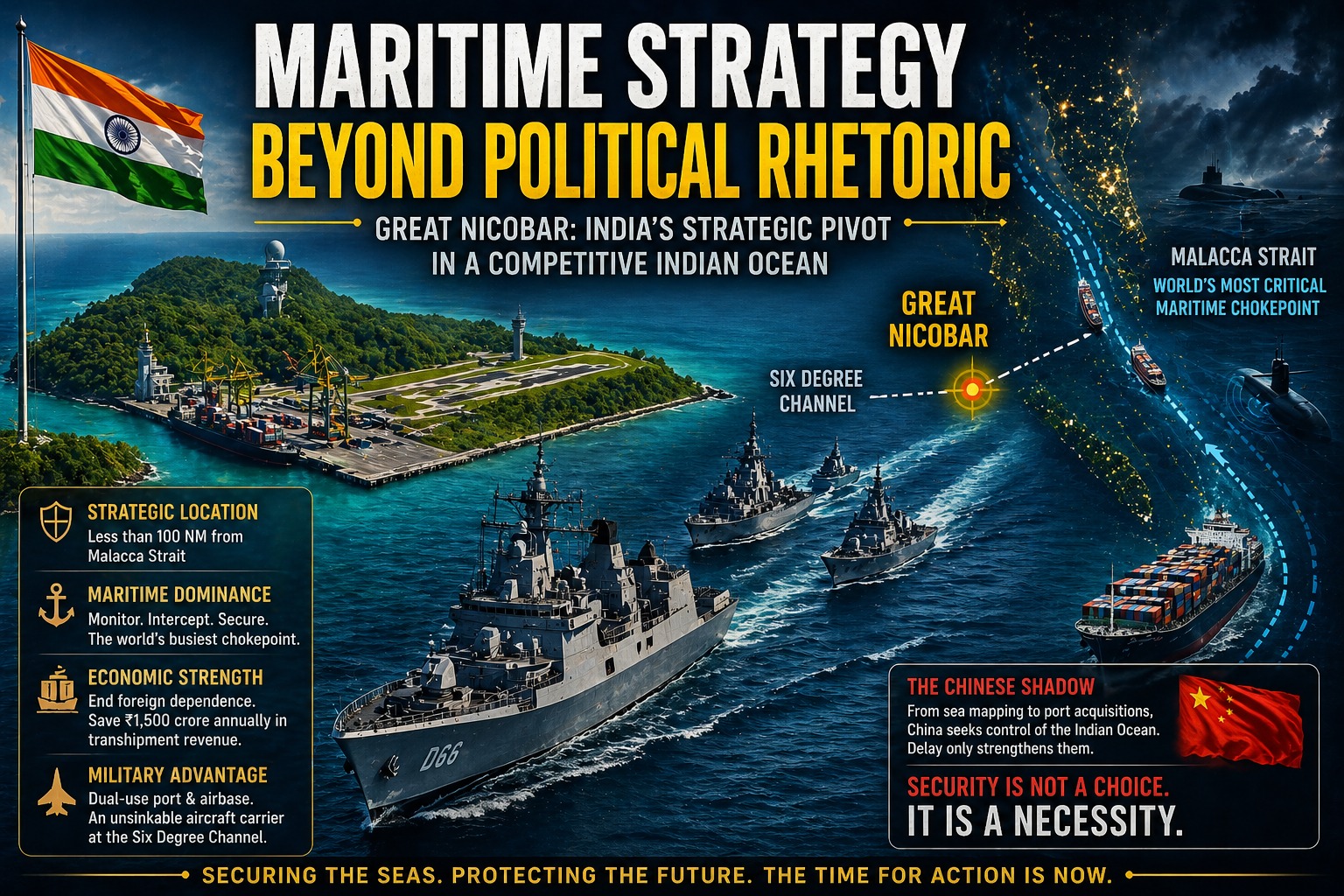
The primary reason Great Nicobar is non-negotiable is the Malacca Strait. This narrow waterway is the world’s most critical maritime chokepoint. The Nicobar Islands sit less than 100 nautical miles from the entrance to the Strait of Malacca. A massive chunk of global trade and energy passes through it. More than 70% to 80% of China’s oil imports pass through this tiny stretch of water. They’ve been spending billions building ports in Myanmar, Pakistan, and Sri Lanka to try and bypass us. China, is terrified of its “Malacca Dilemma”, the reality that its economy could be strangled if a hostile power blocked the strait.
Great Nicobar sits right at the western entrance of this chokepoint. The project includes a 450 MVA power plant and a transhipment hub that will finally free us from dependence on foreign ports. Right now, we’re paying Colombo and Singapore to handle our own cargo. By building a transhipment port and a dual-use military facility there, India gains the ability to monitor, and if necessary, intercept traffic entering the Indian Ocean. As seen from the recent US-Iran Conflict, it’s about having a seat at the table. Without a developed Great Nicobar, India is a spectator in its own ocean.
The China Connection: Cui Bono??
Halting the Great Nicobar project primarily benefits Chinese strategic interests. China relies heavily on Persian Gulf oil, which must transit the Straits of Hormuz and Malacca. A military base at Great Nicobar allows India to monitor and intercept this traffic at the Malacca chokepoint. While China seeks expensive land-based alternatives, such as the CPEC or Myanmar pipelines, to bypass this vulnerability, the Malacca Strait remains its primary maritime route. Beijing views the island’s development as the creation of an “unsinkable aircraft carrier” capable of monitoring or blockading the Six Degree Channel, a vital maritime artery for Chinese trade. Chinese state media has explicitly warned against this military expansion, as it directly threatens their “Malacca Dilemma.”
The project addresses a major economic drain. Currently, India loses ₹1,500 crore annually in transhipment revenue to foreign ports, including Colombo, which operates under significant Chinese influence. Domestically, the project is designed to provide infrastructure and employment for local residents while serving as a critical forward operating base for the Indian Navy.
The opposition narrative, led by Rahul Gandhi, focuses on environmental “crimes” but omits these national security and economic realities. This follows a documented pattern of labelling major strategic initiatives, such as the Rafale acquisition and Central Vista, as “scams” to delay implementation through litigation. By omitting facts about Chinese maritime incursions and the strategic necessity of the Six Degree Channel, this rhetoric prioritises perception over the documented geopolitical requirements of the Indian state.
The Myth of the Scam
Now that the mindset in the corridors of power is finally shifting, the project is being branded a “scam” by critics, led prominently by Rahul Gandhi. They have focused their fire on the environmental and social costs, painting a picture of corporate greed at the expense of indigenous tribes and pristine forests. This narrative is as dangerous as it is shallow. It ignores the reality of how modern nation-states survive.
To argue that developing Great Nicobar is a “theft” of tribal land is to ignore the massive buffer zones and protections already baked into the plan. More importantly, it ignores the fact that if India does not establish a presence there, others will. Nature and geopolitics abhor a vacuum. If the Indian Navy and Indian industry aren’t anchored in the Nicobars, the Chinese People’s Liberation Army Navy (PLAN) will be more than happy to fill the void, whether through covert maritime militia operations or aggressive “research” vessels already prowling the region.
Rahul Gandhi’s opposition seems more about a reflexive need to oppose any project of national significance. Either he is profoundly ill-informed about the maritime security architecture of the 21st century, or he is deliberately misleading the public to score points. By framing a national security necessity as a shadowy business deal, he risks undermining India’s ability to defend its maritime borders. It’s high-octane political opportunism, cynical, and it’s wrong.
The Environmental Argument as a Shield
Of course, the project will impact the environment. You can’t build a world-class port without moving some earth. But the project includes massive compensatory afforestation and strictly defined zones for tribal protection. The Shompen and Nicobarese people deserve a future, but that future won’t be secured by keeping them in a state of artificial isolation while foreign trawlers and spy ships operate just offshore.
The environmental argument is often used as a convenient shield by those who want to prevent India from achieving its full potential. They believe in the doctrine of “soft” power that doesn’t ruffle any feathers. But soft power is useless without the hard power to back it up. A nation that cannot protect its maritime frontiers cannot protect its environment in the long run anyway. If the region becomes a conflict zone due to a power imbalance, the ecological damage will be far worse than anything a port construction project could cause.
Debunking the Hyperbole of “Scam”
The Great Nicobar project has faced significant criticism from Rahul Gandhi, who fhas labelled the initiative a “scam.” He deliberately ignores the fact that the National Green Tribunal (NGT) cleared the project following a rigorous multi-year review, mandating a 30-year mitigation plan that includes coral translocation and the establishment of wildlife sanctuaries.
His claims regarding environmental destruction are statistically unsupported. While Gandhi alleges “millions” of trees will be felled, the official estimate is approximately 964,000. Furthermore, the development occupies only 18% of the island, leaving over 80% of the forest untouched.
Regarding corporate involvement, the project is led by NITI Aayog and implemented by the government-owned ANIIDCO. Regulations require any joint venture to be majority-owned by Indians. Currently, India loses ₹1,500 crore annually in transhipment revenue to foreign ports like Colombo, a facility under significant Chinese influence. Developing an indigenous hub recovers this lost revenue and secures a critical maritime asset.
The Real Cost of Politics Over Security
The ₹81,000-crore Great Nicobar project is a strategic necessity that Rahul Gandhi’s rhetoric systematically ignores. His claim of universal local opposition is factually incorrect; many residents support the project for the promised hospitals, connectivity, and employment. By labelling the initiative “wholesale theft,” Gandhi prioritises a narrow environmental narrative over the reality of integrated development and national defence.
His stance deliberately omits the critical security vacuum in the Bay of Bengal. While Gandhi focuses on “crimes” against the forest, he fails to address the strategic advantage China gains from every delay. India remains economically dependent on Chinese-influenced ports like Colombo, losing vital revenue and maritime leverage. National security requires the hardening of the “Six Degree Channel” with concrete, steel, and surveillance—necessities Gandhi dismisses in favour of photo opportunities. Ignoring these geopolitical facts to stall development constitutes a major disservice to India’s sovereign interests and long-term maritime security.
The Necessity of Action
India’s era of “masterly inactivity” is a strategic failure that ends now. National security is not a negotiation, and Great Nicobar is the non-negotiable anchor of our maritime sovereignty. For seventy years, “benign neglect” surrendered our backyard to rivals; continuing this paralysis is a dereliction of duty. Critics like Rahul Gandhi, who mask their obstructionism in “scam” narratives, either fundamentally misunderstand naval strategy or deliberately choose to weaken the state. By opposing this fortress at the mouth of the Malacca Strait, they give Beijing a strategic advantage. India is reclaiming the Chola legacy to control the world’s most vital sea lanes. But a nation that controls the Nicobars isn’t easily pushed around. And that’s why this project is the most important thing we’re doing right now.




Leave a Reply