
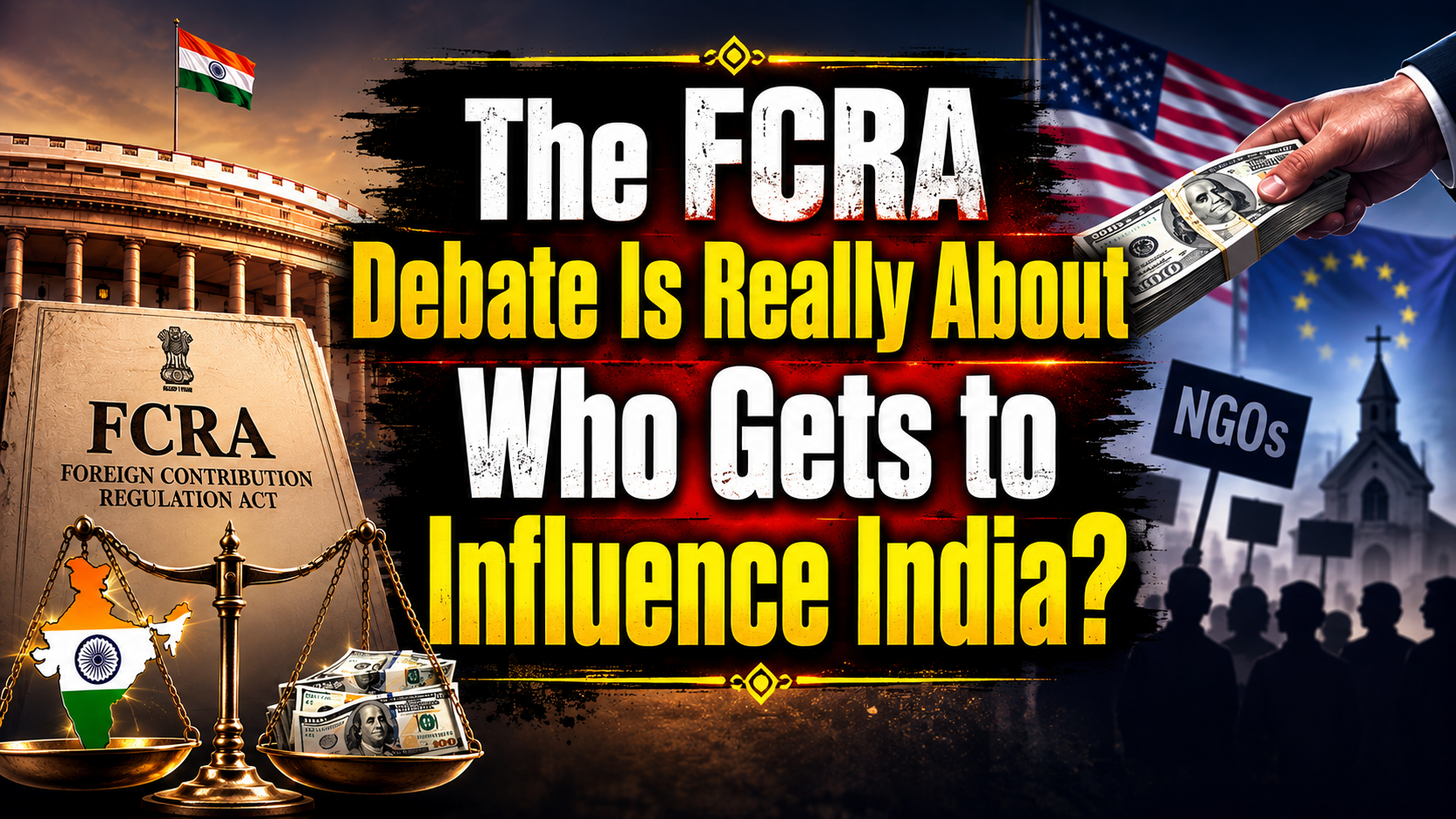
The amendments in Foreign Contribution Regulation Act are likely to be discussed this parliament session. The proposed amended bills is already facing critism from two very different quarters. India’s Opposition parties, particularly the Congress, are portraying the proposed changes as an attack on civil society and religious institutions. In the United States, Congressman Riley M. Moore has described the proposed legislation as an attack on Christians and warned that it could become a matter of concern in the bilateral relationship. The language is different, but the discomfort is remarkably similar.
This similarity of thought of Indian opposition and certain western powers needs to be understood as FCRA is not a law invented by the present government to control NGOs. Its history goes back almost five decades, and much of which was during Congress governments.
On August 4, Moore wrote that Christians had been present in India since the time of St Thomas ( which itself is a contested claim) and alleged that Parliament was considering changes that would permit government takeovers of churches and religious charities. He called this “a clear attack against Christians” and linked the issue to India US relations. That is a serious allegation, but it also reduces a complicated question of foreign funding and national regulation to a question of religious persecution. The FCRA deals with something much wider: who can receive foreign money, where that money can go, what it can be used for and what happens when an organisation violates the conditions under which it was permitted to receive it.
The FCRA was enacted in 1976, during Indira Gandhi’s government. Rajiv Gandhi’s government amended it in 1984 and made registration with the Ministry of Home Affairs mandatory. Then, in 2010, the Congress led UPA government replaced the 1976 law with a new FCRA when P Chidambaram was Home Minister. Among other changes, registration became subject to renewal every five years, and several restrictions on the use and transfer of foreign contributions were tightened. The point is worth remembering because the same political party that now describes tighter FCRA regulation as an assault on civil society had itself repeatedly strengthened the framework when it was in power.
Why did Indira Gandhi’s government feel the need for such a law in the first place? The answer lies partly in the politics of the Cold War which saw the penetration of Indian political and social institutions by foreign intelligence agencies, particularly the CIA and KGB. Universities, student organisations, newspapers, publishing houses, political networks and other institutions were suspected to be foreign influenced.
Foreign powers have always tried to influence countries through institutions that sit outside formal government, and India was hardly going to be an exception.
The underlying problem is quite simple. Foreign money can be perfectly legitimate. But money creates relationships, and relationships can create influence. Influence becomes a national security issue when the source of the money has an objective that is different from the interests of the country receiving it. That was the thinking behind FCRA.
The law was never based on the assumption that every foreign donation was suspicious. It was based on the more practical assumption that a sovereign country should know who is financing organisations operating within its territory and what those organisations are doing with the money.
The nature of foreign influence also changed after the Cold War when foreign influence increasingly moved away from the older intelligence model towards a more indirect system involving NGOs, foundations, advocacy groups, research organisations and grassroots networks. A foreign organisation could finance an Indian NGO, which could then move money through several layers before it reached smaller organisations or local campaigners. The money could be described as being for research, consultancy, field surveys or administrative expenses, while its eventual use could support mobilisation around a particular project or policy.
This does not mean that every NGO receiving foreign money is a foreign agent. That would be stupid to even think that. India has thousands of organisations doing useful work with international assistance. Hospitals, schools, disaster relief organisations, charitable institutions and organisations working with disadvantaged communities have all benefited from foreign contributions. The issue arises when the line between legitimate charitable activity and political mobilisation becomes blurred, or when money received for one declared purpose is used for another.
Kudankulam remains the clearest example and the concern was raised by the Congress government itself. In 2012, Prime Minister Manmohan Singh spoke about foreign funded NGOs involved in protests against the Kudankulam nuclear power project. He said that many NGOs were funded from the United States and Scandinavian countries and did not fully appreciate India’s development challenges. The UPA government also investigated NGOs over alleged diversion of foreign contributions connected with the protests.
P Chidambaram, then Home Minister, also spoke about the issue. The government’s position was that there was evidence of foreign contributions being diverted from their declared purposes and used in connection with activities around the Kudankulam agitation. The point is important because the present discordant noises over FRA sometimes suggeststhat scrutiny of foreign funded NGOs began only after 2014. It did not. The UPA government itself recognised that foreign funding could have consequences for development projects and internal security.
India is building infrastructure at a scale that inevitably creates disputes. Environmental concerns can be genuine. Displacement can be genuine. Questions about safety can be genuine. Some projects deserve to be redesigned and some may deserve to be stopped. But a country cannot allow foreign money to become an invisible participant in every major development dispute. A project can be delayed through protests, litigation and administrative challenges for years. Costs rise, private companies lose interest and governments eventually move on to other priorities. No foreign government needs to openly oppose the project if money and influence can achieve the same result indirectly. This is precisely why establishing the financial trail is important.
India has a long Christian history, and churches have been part of Indian society for centuries. Christian organisations run schools, hospitals and charitable institutions across the country. That work should not be confused with unlawful activity. The same principle applies to organisations belonging to every other religion. Religious identity cannot itself be treated as evidence of wrongdoing.
But religious freedom does not mean exemption from financial regulation. If an organisation uses foreign contributions for activities prohibited by Indian law, the source and utilisation of that money become legitimate matters of public concern. There has been allegations of foreign funded conversion activity in several parts of India. Those allegations should be tested through evidence and due process. At the same time, conversion cannot be placed beyond scrutiny simply because the organisation involved is religious.
That is why the argument that the proposed FCRA changes are essentially an anti Christian measure is difficult to sustain without examining the actual provisions. The proposed framework deals with foreign contributions and assets when an organisation’s FCRA registration is cancelled, surrendered or ceases because it is not renewed. The question is what happens to assets created with foreign contributions once an organisation loses the legal ability to receive or use such funds. The proposed changes provide for a designated authority to manage such assets in specified circumstances. The religious character of a place of worship is to be preserved. That is a question of financial regulation and asset management, not a decision about the religious identity of a church.
The same principle apply to all other religious institutions. If a religious organisation receives foreign contributions lawfully and uses them lawfully, there is no reason for it to fear scrutiny. The problem begins when the money trail becomes opaque, when funds move through several intermediary organisations or when the declared purpose bears little resemblance to the eventual activity.
This is why greater transparency in the chain of foreign funding is important. There can be a situation in which money originating with a foreign donor could move through several organisations before reaching the final recipient in India. Under the proposed approach, the origin and movement of the money would have to be more clearly disclosed. The principle is straightforward: the donor should be identifiable, the intermediary should be identifiable, the recipient should be identifiable and the purpose should be identifiable. There should be a record showing where the money came from and where it finally went.
There is nothing particularly Indian about this approach. Western countries themselves have laws governing foreign donations, foreign agents and foreign influence. The United States has the Foreign Agents Registration Act and a broader regulatory system concerning foreign funding and lobbying. European countries, Canada, Australia and other democracies also impose restrictions and disclosure requirements in different forms. The existence of such laws is accepted as part of protecting domestic institutions from undisclosed foreign influence. Yet when India strengthens its own system, the discussion can quickly move from regulation to accusations that democracy itself is under threat.
That is where the current convergence between sections of India’s Opposition and some Western voices becomes interesting. Their motives need not be identical. Congress has its political reasons for opposing the government. Christian organisations have their own concerns about the effect of the legislation. Foreign governments and international advocacy groups have their own interests in how Indian civil society operates. Yet all of them can arrive at the same political position: that tighter regulation of foreign funding is dangerous. The common argument is that restrictions on foreign funded organisations weaken civil society. That assumption deserves examination.
Democracy requires freedom of association, but it also requires transparency. These two principles are not incompatible. An Indian citizen should be able to establish an NGO, campaign against a government policy, oppose a development project, approach a court and criticise the government. A foreign organisation should also be able to provide legitimate charitable assistance where Indian law permits it. None of these freedoms requires the Indian state to give up its right to know who is financing an organisation and what that organisation is doing with the money.
This is particularly relevant to national security because foreign influence no longer has to resemble the Cold War model of an intelligence officer meeting a politician. It can operate through funding, institutions, advocacy, research and litigation. It can also operate through narratives that acquire political force without their financial origins being immediately visible. That is why the distinction between legitimate civil society activity and foreign funded influence operations cannot be dismissed as paranoia.
There is also a practical point about the scale of foreign funding. The annual foreign inflows is between ₹18,580 crore to ₹22,000 crore each year. When evaluated against the backdrop of India’s national budget, this foreign funding is equivalent to less than 0.5% of the central government’s annual expenditure which stands at around ₹53.47 lakh crore. The argument that stricter FCRA rules will somehow bring India’s welfare system to a halt is therefore difficult to sustain. Yes, the proposed mandatory ₹10 lakh trailing expenditure rulemay impact small, rural charities that rely on modest international donations for critical local welfare work.The government maintains that the non-negotiable ₹10 lakh spending floor is a uniform administrative upgrade designed to eliminate dormant shell organizations and close loopholes for unchecked foreign funding.
An American legislator is entitled to raise concerns about religious freedom. India should listen when legitimate questions about civil liberties are raised. But India can also expect the same respect for its sovereign right to regulate foreign money that Washington expects for its own laws. If an Indian politician demanded that the United States change its foreign influence laws because they affected an Indian funded organisation, the response from Washington would almost certainly be that American law is a matter for the American legislature.
India can make the same argument.
The FCRA debate should therefore be brought back to its proper ground. It is not a debate about whether India has Christians. It is not a debate about whether NGOs are useful. It is not a debate about whether citizens have the right to protest. It is a debate about foreign money, transparency and the possibility that financial influence can become political influence.
Indira Gandhi’s government understood that problem in the 1970s. Rajiv Gandhi’s government tightened the system in the 1980s. The Congress led UPA government replaced the old law in 2010. Manmohan Singh and P Chidambaram then confronted the foreign funding question during the Kudankulam protests. The political positions may have changed since then, but the underlying problem has not disappeared. India still has to decide how much foreign money can enter its civil society space, under what conditions and with what level of disclosure.
A foreign donation is not a crime. But foreign money should not become invisible influence. That is the central question the FCRA debate should answer. And if the answer is simply that organisations receiving foreign money should disclose its source, account for its use and comply with Indian law, it is difficult to understand why that principle should frighten either Indian political parties or foreign lawmakers.


Leave a Reply