
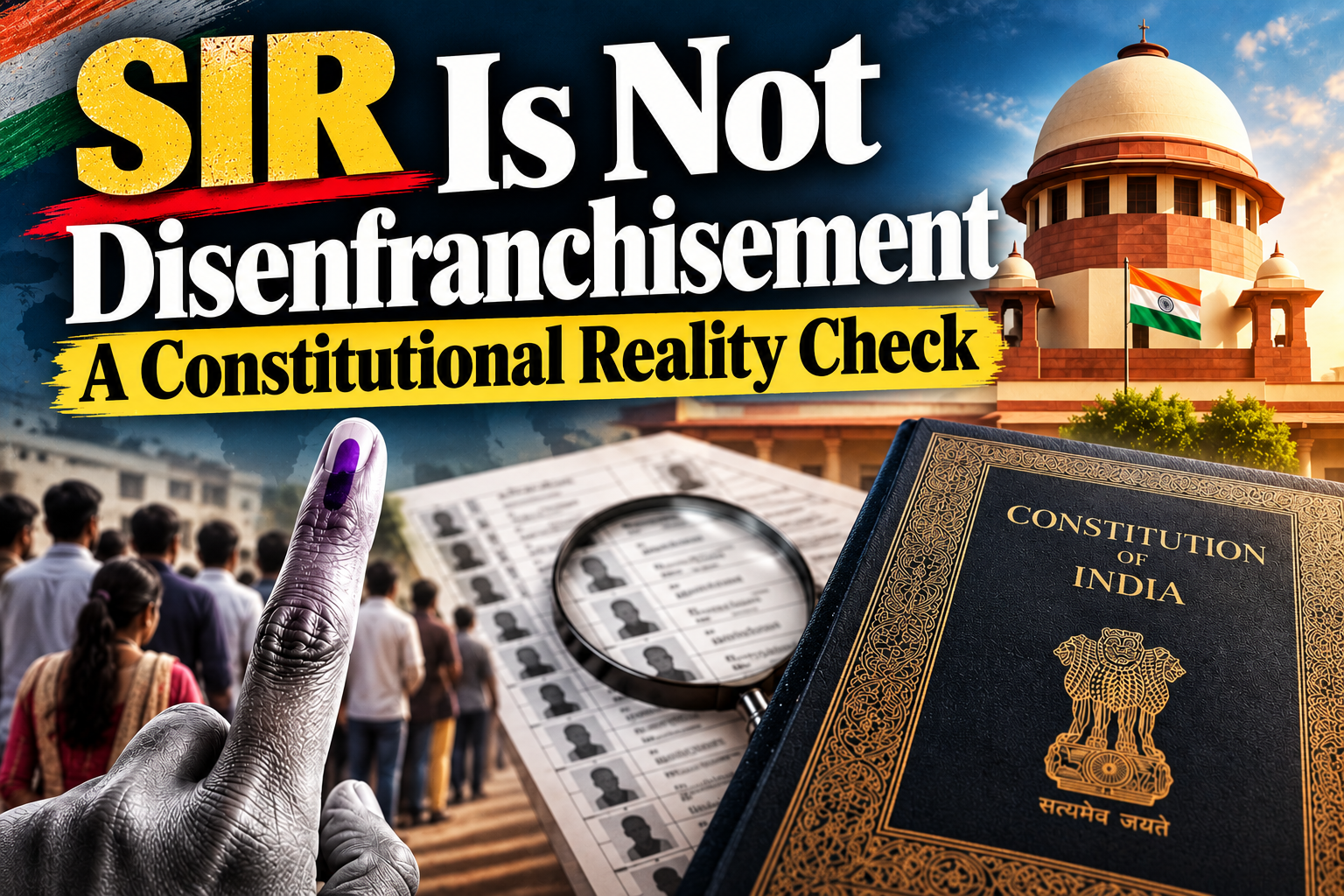
– A.S. Santhosh
No citizen has a vested right to be included in the electoral list irrespective of compliance with the statutory process regulating their right to vote nor can any political party be vested with the plea of continuing an imperfect and an impure electoral roll , which would be a death knell for a free and fair election. Any procedure which embodies a hearing process during the course of revision and provides for two post decisional appeals, can neither be arbitrary nor be causative of two classes of citizens.
There is a legal term, “adverse possession”. A person who has been in possession of a property for a long time can, subject to the legal requirements, plead adverse possession and challenge the title of the original owner. There seems to be an impression that the same principle applies to the voters’ list also. Just because a person’s name is there in the voters’ list, he does not acquire a vested right and cannot say that the entry of his name in the electoral roll can never be questioned. When there were summary revisions, lakhs of names were removed in earlier phases. Then there were no such agitations. Why now? Only to create anarchy.
Lakhs of names across a State, and thousands of names in individual Assembly constituencies, many of them involving illegal intruders, were subjected to verification and cross-checking. If such persons, who were not legally entitled to be on the electoral roll, were allowed to remain, participate in elections and influence electoral outcomes, the very purpose of democracy would be defeated. The Constitution is not defeated by the removal of such dubious names through a lawful process; rather, democracy is undermined when such names are allowed to remain and influence the electoral process. Removal of such names, therefore, is not anti-constitutional; permitting dubious entries to continue unchecked is what poses a threat to the integrity of the democratic process.
The whataboutery implicit in the conundrum is that a political party cries foul of the electoral process citing multiple entries on the voters list conflating it with the imminent occurrence of multiple votes. The proposition being a no brainer, it turns around when there is a process of cleaning up the electoral roll, which shorn of drummed up and shrill propaganda, has resulted in cleaning up the electoral lists.
The assumption that everybody is included in the voters list is a lawful Indian only displays naivety. It is in public domain that securing inclusion in the electoral list, fraudulently was one of the many ways of gaining citizenship in the country, unlawfully. A broad brush condemnation of a constitutionally, consecrated process, without any insight into the logistics involved can only add noise to the humdrum without any substance.
The process of determining the legality of the exercise, undertaking, deletion and inclusion is still at large in the appeals that have been filed by the affected parties. There may be a case made out about the exclusions, which were beyond the parameters set for the intensive revision. The possibility of that occurrence by itself does not call for denouncing of the entire exercise, sanctioned under statute and found imperative for the purpose of conduct of elections. The volume of such solutions or inclusion by itself is not determinant of the legality of the process, resulting in such a consequence. Any statutory action of any authority is amenable to judicial review. Treating a process, constitutionally invested in a high ranking body as presumptive of arbitrary exercise of power is to exhibit our bias in the subject matter or just the orientation therefor.
To contend that the denial of a right to vote as a consequence of exclusion from the electoral list in pursuance of SIR, results in two classes of citizens in this country is a flawed reasoning. Paras 186(f) of the judgement of the honourable Supreme Court in the case of Association for democratic reform and others Vs. Election commission of India, delivered in May 2026 clearly holds that the process of SIR and the exercise of the election commission includes its power to make a limited enquiry into citizenship for the purpose of satisfying itself as to eligibility for inclusion. It does not deny any other claim of that person for citizenship under the citizenship act. To postulate to the contrary would be in the teeth of a judgement of the Supreme Court, which binds all citizens of the country, including the Honourable judges. For an Honourable judge to seize an out of turn occasion in a public forum to cause any disaffection with the judicial process being obviously unmindful of all the facets involved of that exercise, does not elevate anyone.
For a sitting, Supreme Court judge to speak out of turn in regard to matters which are pending for adjudication before the appellate mechanisms under the SIR dispensation is nothing short of judicial misconduct. No amount of self-rightness, justify such an utterance by a judge of the court.
(The views expressed are those of the author, a legal activist based in Hyderabad.)

Leave a Reply