
By: Kuldeep Jha
In an alarming episode, The Hindu newspaper published a false report claiming that three Indian fighter jets had crashed.
The story, attributed vaguely to a “government official,” was not just inaccurate — it was entirely fabricated.

The false report was swiftly picked up by Chinese and Pakistani media outlets. In the modern information battlefield, disinformation is not just a nuisance — it is a weapon.
This is not merely journalistic malpractice. In today’s era of hybrid warfare, information manipulation has become a core tactic of adversarial states.
In the modern information battlefield, timing is everything — and this disinformation struck a blow just when vigilance was most critical.

What followed was even more disturbing: The Hindu quietly deleted the article without issuing a retraction, correction, or apology. There was no acknowledgment of error, no attempt to clarify. But by then, the damage was done. The story had been embedded in the international news cycle, giving adversaries of India a free hand to discredit the country’s military competence and governance.

Back in 2017, General Bipin Rawat, India’s first Chief of Defence Staff, made a stark observation: “We are prepared for a two-and-a-half-front war — two external fronts (Pakistan and China), and half front being internal security threats.” This “half front” was not a hypothetical. It referred to the insidious threat from within — misinformation, disinformation, and media narratives that weaken national unity and resilience from inside.
In this light, The Hindu’s conduct is not just a journalistic lapse — it borders on compromising national security.
Pattern or Coincidence?
This isn’t The Hindu‘s first brush with controversy. During the Rafale jet deal saga in 2019, the paper ran a series of stories aimed at discrediting the government’s procurement process. While couched in the language of transparency and accountability, many of these stories lacked complete context or were later challenged by independent analysts.
The timing and tone often aligned more with political agendas than journalistic inquiry, feeding opposition narratives and amplifying skepticism about India’s defense preparedness — a stance that foreign adversaries were only too happy to echo.

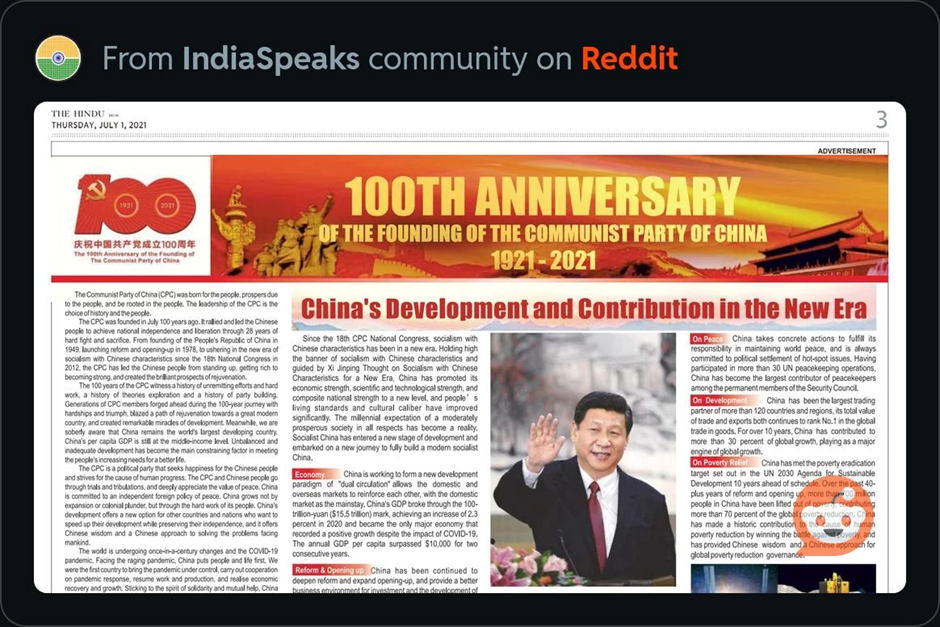
Worse still, The Hindu has been known to publish full-page advertisements promoting the Chinese Communist Party (CCP) — even as China’s aggressive posturing on the Ladakh border continues and its alliance with Pakistan grows stronger. In an era when Chinese apps are banned, and Chinese investments scrutinized for national security risks, such acts of media cooperation raise serious red flags.
India does not need a censored press. But it does need a conscientious press. One that doesn’t mistake rumor for fact, or political vendetta for investigative reporting. In the information age, where wars are waged not just with missiles but with narratives, the media’s role becomes critical — not just in informing citizens, but in defending the nation’s truth.
The question must be asked: Should publications that consistently flirt with misinformation and amplify hostile narratives be allowed to influence public discourse without scrutiny?
India deserves a press that is free — but never free enough to become the enemy’s propaganda tool.
It deserves journalism that defends truth — not erodes it from within.




 Arise Bharat
Leave a reply to Anonymous Cancel reply