
-A.S. Santhosh
An analysis of the structure, funding, and India operations of The Timothy Initiative, in light of emerging regulatory scrutiny.”
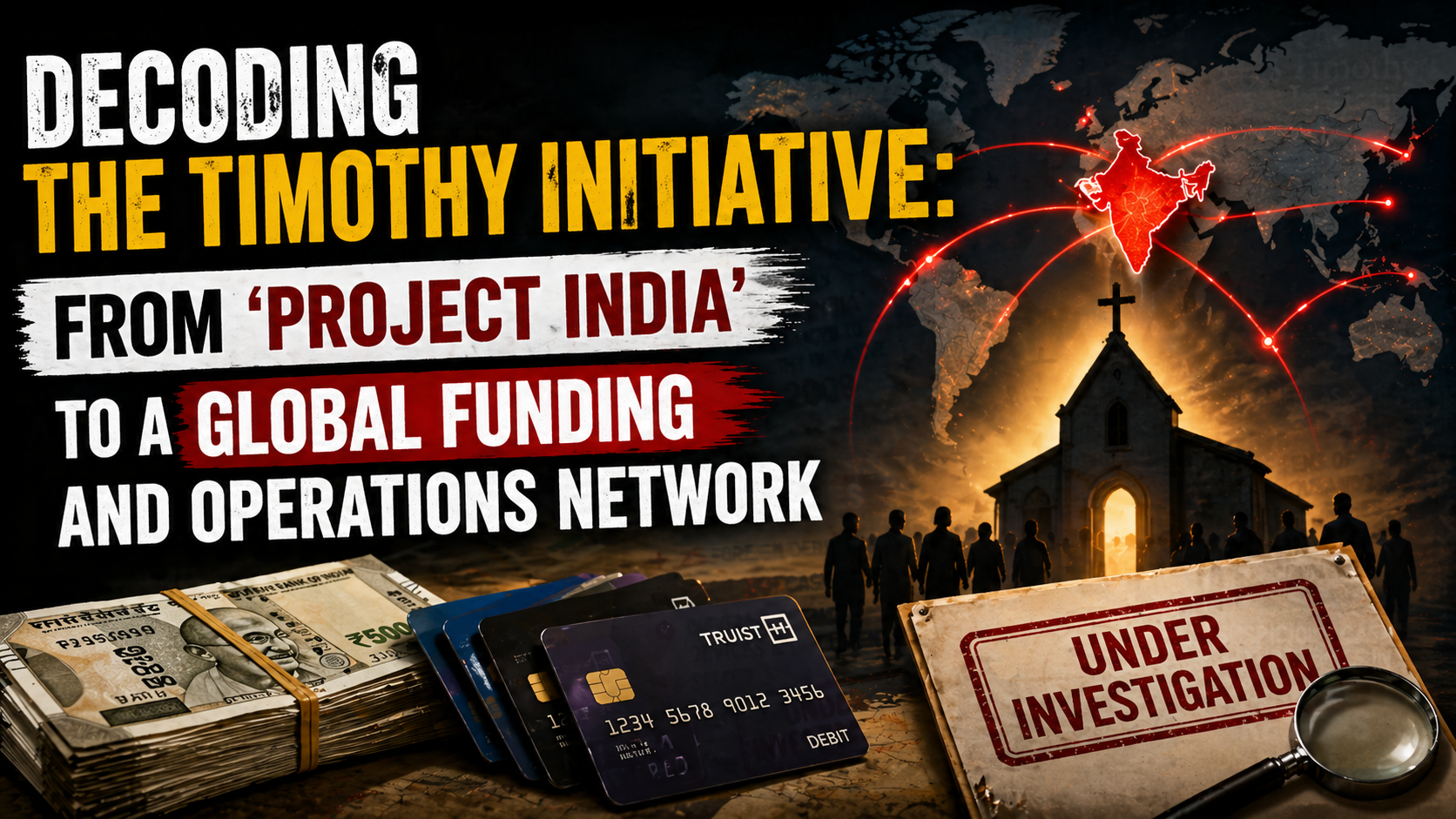
A major financial and national security controversy has emerged following the interception of a foreign national, Micah Mark, at Bengaluru International Airport. Acting on a Look-Out Circular (LOC) issued by the Enforcement Directorate, officials of the Bureau of Immigration detained him while he was bringing foreign debit cards into India. A total of 24 foreign debit cards were recovered from his possession, triggering a nationwide probe into a suspected covert financial network linked to The Timothy Initiative.
The investigation, initiated under the Foreign Exchange Management Act, has revealed what authorities describe as a highly organised financial operation. Foreign bank debit cards linked to Trust Bank, USA were brought into India and used for repeated cash withdrawals from ATMs across multiple states. Crucially, these funds were not transferred through formal banking systems or through channels compliant with the Foreign Contribution (Regulation) Act but instead were routed as cash withdrawals, bypassing regulatory oversight.
The investigation indicates a structured modus operandi wherein foreign bank-issued debit cards, linked to overseas accounts, were physically brought into India and used for repeated high-value ATM withdrawals. The withdrawn cash was subsequently utilised for activities associated with The Timothy Initiative in India. The use of a billing and accounting online platform, reportedly controlled from outside India, to track withdrawals and utilisation further points to a centrally coordinated yet locally executed financial architecture.
The Enforcement Directorate has confirmed that approximately ₹95 crore was channelled into India between November 2025 and April 2026 using these foreign-issued debit cards. The investigation has revealed the involvement of multiple individuals across different parts of the country, indicating a coordinated and organised network.
A critical dimension of the probe is the geographic pattern of withdrawals. Authorities have identified significant cash withdrawals in Left Wing Extremism affected regions, particularly Bastar and Dhamtari in Chhattisgarh, where approximately ₹6.5 crore has been withdrawn over time. These transactions were carried out in a planned and repetitive manner using foreign debit cards, indicating the possible involvement of organised networks. This pattern suggests the emergence of a parallel and unregulated cash-based economy within Naxalite-affected areas, raising serious concerns for financial integrity and internal security.
During search operations conducted on April 18 and 19, 2026, across six locations in multiple states, the Enforcement Directorate seized 25 foreign bank debit cards, ₹40 lakh in cash, and various incriminating digital devices, documents, and electronic evidence. Investigators also identified the use of a foreign-controlled accounting platform to monitor ATM withdrawals and their end use.
From “Project India” to Global Expansion Network
At the center of this network is The Timothy Initiative, Inc. (EIN: 80-0472803), headquartered at PO Box 98177, Raleigh, North Carolina, USA. As per its IRS Form 990 disclosures, the organization states its mission as: “to advance Christ’s kingdom by multiplying disciples and disciple-making churches around the world.”

This is not merely a general charitable mandate but a structured global expansion model focused on church multiplication, leadership training, and evangelism in regions described as “unreached,” including India. Importantly, the same filings indicate that Sweetlin Manoharan, an individual of Indian origin, is listed among the organisation’s directors. This indicates the active cooperation and participation of individuals of Indian origin within the organisation’s leadership and decision-making structure.

Financial disclosures for the financial year 2023 submitted to the US Government’s IRS Portal show total revenues of $22.66 million, approximately ₹188 crore, and program expenditures of $18.82 million, with nearly 46 percent of spending directed outside the United States. Notably, $1.29 million, equivalent to over ₹10 crore, has been allocated to South Asia during the same reporting period.
The filings also document direct grants for “church planting” and “operations,” along with non-cash distributions such as “audio Bibles,” indicating a structured funding pipeline supporting religious expansion through local networks.
India-Centric Origins and Local Participation
Additional internal literature further reinforces India’s centrality to its origins. A publication titled Disciples Making Disciples – Level 1, USA Edition dated June 18, 2020 states that the organisation was originally known as “Project India,” reflecting its initial focus on India as the starting point of its activities. It later adopted the name “The Timothy Initiative” in 2009 and expanded globally across 42 countries.

The publication also acknowledges contributions from individuals of Indian origin, including Samuel Selvamony and Krishna Ghimire, reflecting not only governance-level but also operational and intellectual participation linked to India.
Regulatory and Transparency Concerns
A critical regulatory issue arises from the fact that The Timothy Initiative is not registered under the Foreign Contribution (Regulation) Act, which governs the receipt and utilisation of foreign funds in India. Despite this, both financial disclosures and external communications indicate sustained engagement with the country.
A further concern is the limited digital accessibility of the organisation within India. Its official website is not accessible from Indian IP addresses and displays a restricted access message. While such geo-restrictions may have administrative explanations, they reduce transparency and hinder independent scrutiny, particularly in the context of ongoing investigations.

Additionally, international church networks have reportedly supported activities linked to The Timothy Initiative in India. A Facebook post by Kensington Church describes The Timothy Initiative (TTI) as its “global partner” and highlights its operational model of “making and multiplying disciples, churches, and leaders.” The post explicitly states that their partnership has resulted in the establishment of over 3,000 house churches in northern India, a region described as predominantly Hindu. It further notes that a group of eight churches collectively committed to raising $1 million to support these activities in India . This disclosure is significant as it provides direct evidence of organized international fundraising directed toward church expansion activities in India, reinforcing the existence of a coordinated global funding ecosystem linked to TTI’s operations.

Policy and Security Implications
Taken together, the case points to a complex and multi-layered operational architecture involving declared foreign funding, decentralised execution, digital coordination, and alleged use of informal cash transfer mechanisms. The ongoing investigation is focused on identifying local beneficiaries and intermediaries, mapping cash distribution channels, and conducting forensic analysis of foreign-controlled financial systems.
As the investigation progresses, it is expected to have far-reaching implications for India’s regulatory and enforcement framework, particularly in addressing non-traditional cross-border financial flows and their intersection with sensitive internal security environments.




Leave a Reply