
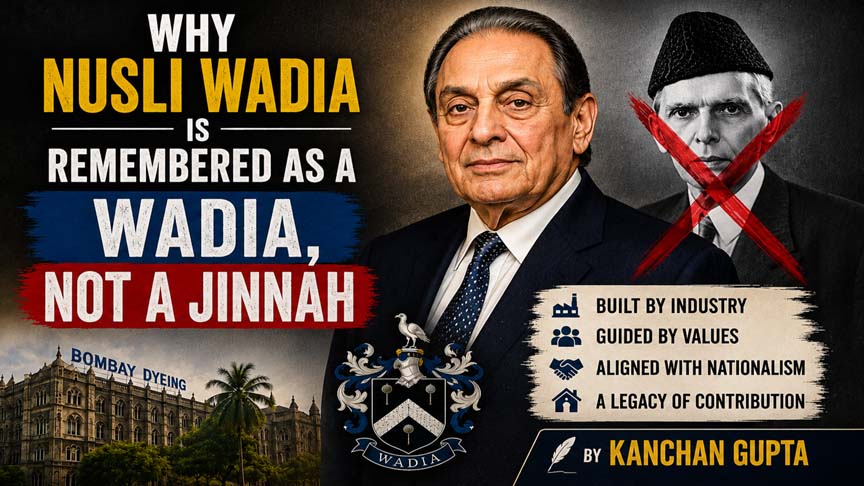
- Kanchan Gupta
The clickbait politics of corruption-tainted Arvind Kejriwal and his Aam Admi Party is as contemptible as eyeball-grabbing clickbait journalism.
Why would BJP want to hide facts that are widely known and are a part of history in more ways than compulsive liar Arvind Kejriwal and his malicious disinformation spreading AAPiya groupies ever will be?
Mohammed Ali Jinnah married Rattanbai Petit, known as ‘Ruttie’ in fashionable drawing rooms, of the famous Petit family of notable Bombay Zoroastrians when she was 18. That was in 1918 and her family disowned her for marrying a Muslim more than twice her age.
In 1918 Jinnah was a prominent member of the Congress as well as Muslim League leadership. Jinnah’s politics of the time were focused on constitutional reforms and Hindu-Muslim unity.
As a leader of the Congress and the League, Jinnah opposed the Rowlatt Act. He also led the protest against British recruitment of Indian sepoys for World War I unless Indians gained equal rights.
In brief, Jinnah of 1918 was a staunch ‘nationalist’ as defined then; Ruttie, though from an Anglicised family, was a nationalist too — in brief, their political views matched and by all accounts they were happy as a couple. A year later their daughter Dina was born.
The proverbial bone in the kebab was Jinnah’s sister Fatima who refused to accept that her brother could ever love another woman. Like a vulture she hovered over Jinnah till his death, refusing to let anybody come anywhere near him. Despite her constant vigil, Tuberculosis did embrace Jinnah (or was it the other way round?) and gnawed away at his tobacco-tarred lungs. Jinnah died gasping for breath.
But that is not the story we want to recall. Our story is about Ruttie and Dina.
Tired of Fatima’s presence like a purdah between her and her husband, and his divided affection, Ruttie separated from Jinnah in 1927 and moved out of her marital home with eight-year-old Dina. Two years later Ruttie died of undiagnosed health issues and depression.
In 1927, Jinnah’s politics were yet to take the form and shape of Muslim separatism that would scorch India. He was still focused on creating a ‘united front between the Indian National Congress and the All-India Muslim League’ to counter British rule. He led the ‘Delhi Muslim Proposals’, offering to abandon separate communal electorates in exchange for minority safeguards and increased Muslim representation at the Central level.
Jawaharlal Nehru and his father Motilal Nehru, in their 1928 ‘Nehru Report’ on what should be the framework of the Constitution of free India, rejected Jinnah’s proposal for seat sharing and gave most political power to the Central Government instead of the Provinces.
But this story is not about Nehru and his shenanigans. It’s about Ruttie and Dina and how the personal life of the man who broke India and his politics were, in a manner of speaking, intertwined: Ruttie fell in love with and married nationalist Jinnah; their daughter Dina drifted away from, and ultimately disowned, separatist Jinnah.
Dina grew up without a mother, mostly in London, in the long shadow of her aunt Fatima, and scoffing at Jinnah’s objections, she married Neville Wadia, dashing businessman of Bombay and scion of the Wadia Family, in 1938. Both daughter and father became coldly formal and distant; Jinnah began referring to Dina as ‘Mrs Wadia’.
By 1938 Jinnah had begun to position himself as the ‘Sole Spokesman’ of subcontinental Muslims. This year marked the ‘point of no return for Jinnah’. He ‘pivoted from pushing for a united, federal India with minority safeguards’ to demanding a political destiny for Muslims separate from that of Hindus.
After Direct Action Day in 1946 (the year Dina last met Jinnah) Partition became inevitable and the ghastly horrors leading up to August 1947 a foregone conclusion. A triumphant Jinnah, Fatima in tow, abandoned Bombay and relocated to Karachi. His only child, by then a mother of two children, Nusli and Diana, showed no interest in either shifting to Karachi or visiting Pakistan.
This takes our story to Nusli Wadia, Jinnah’s grandson, who, as a young man, prevented the sale of Wadia family-owned Bombay Dyeing by his father Neville Wadia to RP Goenka by buying 11% shares, exhorting workers to use their savings to buy shares, and securing, legend has it, more than generous support from JRD Tata and Bombay House. “Jinnah’s Grandson” went on to become the chairman of Bombay Dyeing and an independent director on the board of several Tata companies, including Tata Steel and Tata Motors.
In the 1960s Nusli Wadia met an enthusiastic RSS Pracharak, Chandikadas Amritrao Deshmukh, popularly known as Nanaji Deshmukh, a graduate from BITS Pilani, whose work in taking education to the hinterland of Gorakhpur in Uttar Pradesh and active involvement in Bharatiya Jana Sangh activities had begun to seep into conversations in Bombay.
Impressed by Nanaji Deshmukh’s work, Nusli began contributing money for his projects and politics. He introduced Nanaji to other prominent Bombay businessmen and industrialists, including JRD Tata, and paved the path for corporate funds to flow towards Jana Sangh. Over the years, the sage-like Nanaji became a spiritual mentor of Nusli and his wife Maureen.
Meanwhile, Nusli met Atal Bihari Vajpayee through Nanaji and a lifelong friendship developed between the two. At one level it was intensely personal: The two could spend hours in companionable silence, exchanging few words, occasionally calling for treats that were otherwise a rarity in the spartan Vajpayee household of those days.
At another level, the larger relationship between Nusli and the BJS, his support to the Jana Sanghis during Mrs Gandhi’s Emergency, and subsequently his funds to nurture the BJP in its early years when few dared to defy a post-1980 vengeful Indira Gandhi, were a reflection of Nusli’s deep commitment to the BJS/BJP’s politics tethered to nationalism.
Neither Nusli nor the BJP, or Atal Ji if you wish, ever shied away from acknowledging their relationship. For the party leadership, Nusli was a Wadia, not a Jinnah.
I was in the PMO when Atalji was PM, serving as his aide. I do not recall seeing Nusli just walking in and out of South Block or Race Course Road, unannounced, unhindered and unchecked.
At the famous post-Pokhran II White House ice-breaker dinner hosted by President Bill Clinton, a bevy of Indian industrialists and businessmen were invited to taste chicken stewed in Darjeeling tea (which was the main course). Nusli could not make it for some reason; his wife Maureen was there — not at the high table, not near the high table, but at a distant low table where she was seated with lowlies like me.
Cut-and-paste authors like Vinay Sitapati, who probably thinks Indians washing and not wiping themselves after defecating is worth being breathlessly described as Ripley’s “Believe It or Not”, getting all excited about “Jinnah’s grandson donating money to BJP” is not unexpected.
Nor is it expected that media will refrain from spinning the asinine excitement of a callow novice into clickbait journalism meant for the lowest common denominator.
Hence, it is perfectly understandable that Arvind Kejriwal and his AAPiyas should use the Jinnah bait to seek attention. Nusli’s contribution to India via Bombay Dyeing has been immeasurably more than what 100 generations of Arvind Kejriwal could ever dream of.
Source: Post on X by Kanchan Gupta

Leave a Reply