
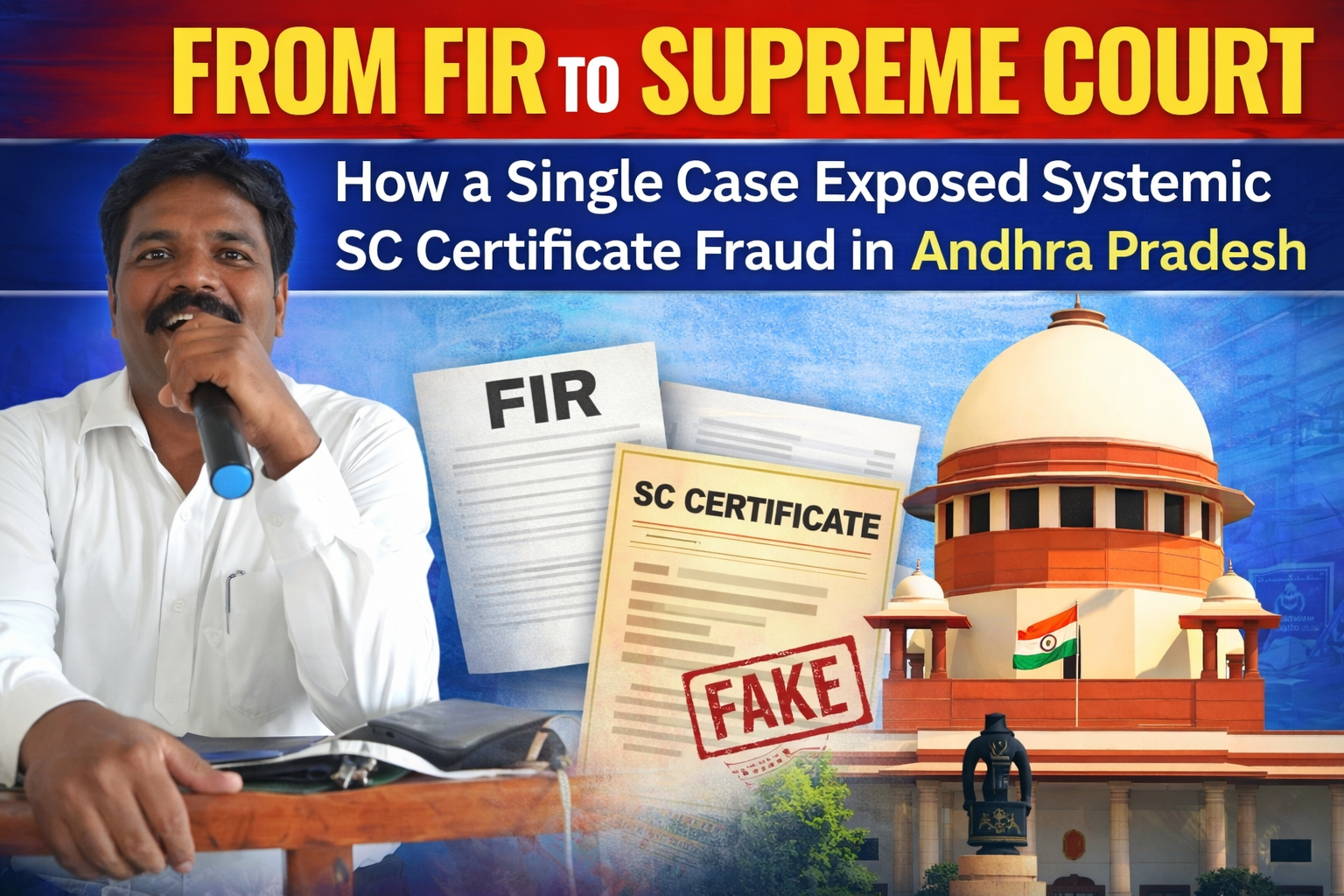
In a significant and conclusive ruling dated 24 March 2026, the Supreme Court of India, in Criminal Appeal arising out of SLP (Crl.) No. 9231/2025, upheld the judgment of the Andhra Pradesh High Court in the very same case involving Chintada Anand, categorically affirming that a person who has converted to Christianity cannot claim Scheduled Caste status under the Constitution (Scheduled Castes) Order, 1950. The apex court’s decision not only brought finality to the dispute arising out of Crime No. 8/2021 of T. Sandole Police Station, but also reinforced a settled constitutional principle that religious conversion severs eligibility for Scheduled Caste recognition and its associated legal protections.
What began as a local criminal complaint has now evolved into a case of far wider significance. The controversy is increasingly being viewed as a classic and representative example of large-scale Scheduled Caste certificate fraud and systemic administrative failure in Andhra Pradesh, exposing how an individual allegedly continued to claim SC status, invoke provisions of the SC/ST (Prevention of Atrocities) Act, and even secure monetary compensation despite clear and documented evidence of conversion to Christianity.
In the wake of the Supreme Court judgment, the Legal Rights Protection Forum (LRPF) has submitted a detailed report to the District Collector, Bapatla, with a copy to the Chief Secretary of Andhra Pradesh, seeking cancellation of the Scheduled Caste certificate, recovery of benefits obtained, and initiation of criminal and departmental action against both Mr. Chintada Anand and the concerned Tahsildar who issued the certificate. The representation also calls for recovery of ₹2.5 lakh paid as victim compensation and prosecution under the relevant provisions of the Andhra Pradesh (SC, ST & BC) Regulation of Issue of Community Certificates Act, 1993.
The origins of the case date back to January 2021, when Mr. Chintada Anand filed a complaint that led to the registration of Crime No. 8/2021 under provisions of the IPC and the SC/ST Act against several villagers. However, during the course of proceedings, substantial material surfaced—including Mr. Anand’s own statements—indicating that he was functioning as a Christian Pastor, conducting regular Sunday prayers, having children with Christian names such as Zudson Paul and Mahiam Paul, and having his marriage solemnized under the Christian Marriage Act. These facts were formally brought to the attention of authorities through a detailed complaint dated 26 April 2021 submitted by Akkala Rami Reddy and others, along with references to G.O.Ms.No.838 (1977) and G.O.Ms.No.159 (1981), which clearly state that Scheduled Caste converts to Christianity fall under the BC-C category and cease to be eligible for SC status.
Despite these objections and documentary evidence, the Tahsildar of Pittalavanipalem Mandal issued a Scheduled Caste certificate dated 20 February 2021 in favour of Mr. Anand, allegedly relying on an outdated school certificate issued nearly two decades earlier, without verifying his current religious status. This action became a central point of controversy, raising serious concerns regarding procedural violations, misuse of authority, and failure of due diligence in the issuance of caste certificates.
The matter eventually reached the Andhra Pradesh High Court, which in its order dated 30 April 2025 (CRL.P. No. 7114 of 2022) quashed the SC/ST Act case filed against the villagers. The Court clearly held that Mr. Chintada Anand had converted to Christianity and therefore could not claim Scheduled Caste status, rendering the invocation of the SC/ST Act legally unsustainable. This finding was subsequently challenged before the Supreme Court, but the apex court affirmed the High Court’s ruling in its entirety, conclusively settling the issue within the framework of constitutional law.
However, what makes this case particularly alarming and why it is now being cited as a model example of systemic SC certificate fraud in Andhra Pradesh is the continued administrative inaction despite clear judicial findings. Multiple complaints, including the original 2021 representation and subsequent grievances filed through the PGRS portal (Grievance Nos. BPT202503105700 and BPT202505263685), failed to result in cancellation of the caste certificate or action against the issuing authority, even after repeated reminders extending up to March 2026.
Equally significant is the allegation that Mr. Anand received ₹2.5 lakh as victim compensation under the SC/ST (Prevention of Atrocities) Act, which, in light of the High Court and Supreme Court rulings in the same case, is now being questioned as having been obtained on the basis of a legally invalid caste claim. The complaint contends that this amounts to a fraud upon the State, warranting recovery of the amount and initiation of criminal proceedings.
Invoking provisions of the Andhra Pradesh (SC, ST & BC) Regulation of Issue of Community Certificates Act, 1993, the Legal Rights Protection Forum has sought prosecution of both the beneficiary and the concerned Tahsildar of Pittalavanipalem Mandal, noting that offences under the Act are cognizable and non-bailable and emphasizing that the District Collector is empowered under Section 5 to cancel false caste certificates.
Taken together, the trajectory of this case, from the issuance of a caste certificate and invocation of protective legislation, to judicial scrutiny and eventual Supreme Court affirmation, illustrates how gaps in verification, lack of administrative accountability, and delayed enforcement can enable misuse of constitutional safeguards on a significant scale. As all developments stem from the same case now conclusively decided by the Supreme Court, it is increasingly being seen not as an isolated incident, but as a definitive case study underscoring the urgent need for systemic reform in the issuance and verification of caste certificates in Andhra Pradesh.


Leave a Reply