
- Col Ajay Kumar (Retd)
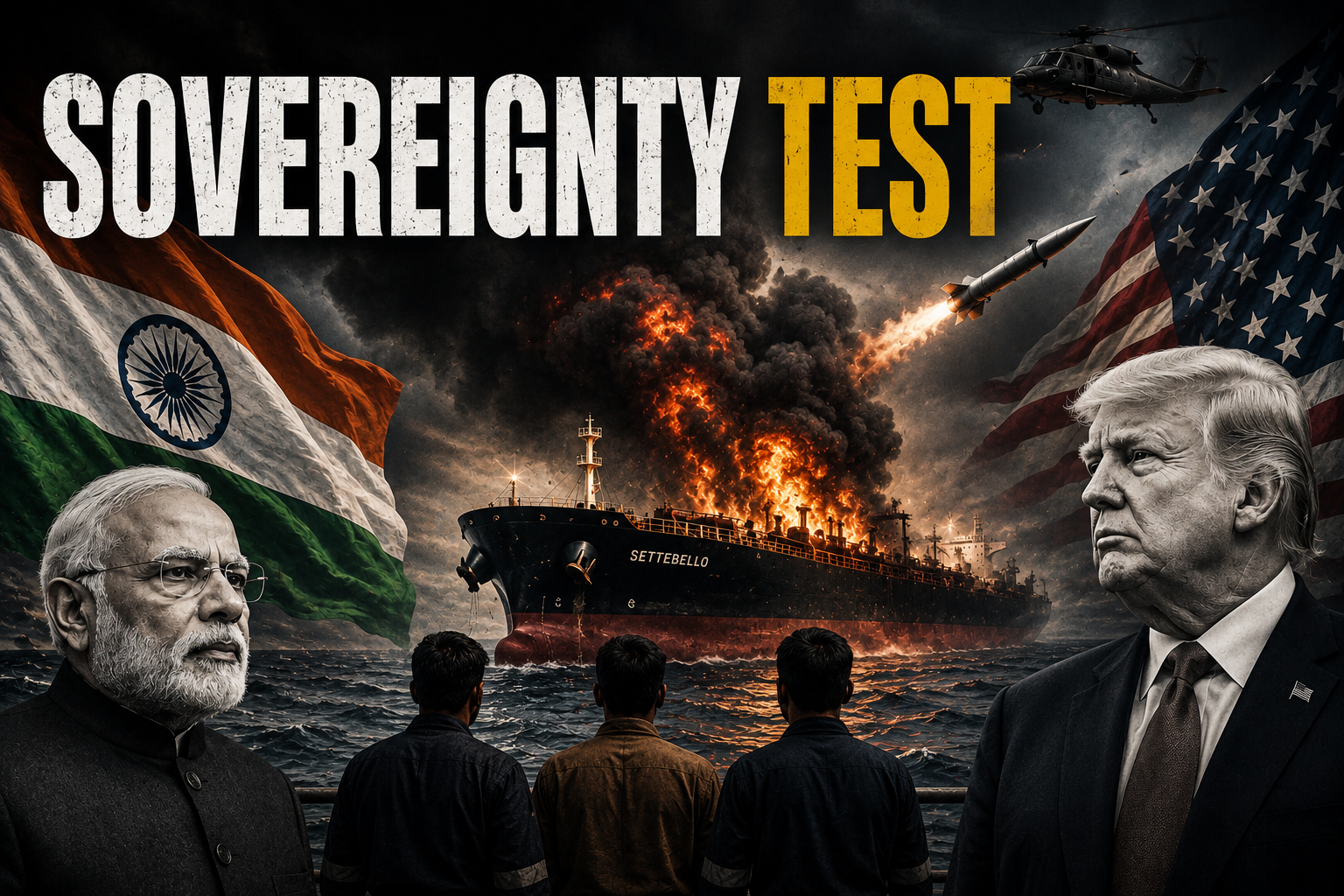
Once again, Bharatiyas got caught in the crossfire! The lethal kinetic action taken by the United States Navy against commercial tankers in the Gulf of Oman has resulted in a severe friction point in the strategic partnership between New Delhi and Washington. The tragedy, which resulted in the deaths of three Indian mariners, has triggered a wave of public outrage in Bharat and initiated a complex debate on national sovereignty, maritime security, and the scope of India’s foreign policy. While the United States defends its operations as a necessary enforcement of its naval blockade against Iranian petroleum exports, India’s foreign policy establishment has forcefully condemned the use of deadly force against civilian seafarers. This crisis occurs at a delicate geopolitical juncture. Prime Minister Narendra Modi is preparing for a critical bilateral meeting with US President Donald Trump on the sidelines of the G7 summit in France. The incident exposes the vulnerabilities of Indian civilian mariners navigating a highly militarized West Asian theatre and the challenges that New Delhi face in balancing its strategic alignment with Washington with its commitment to protecting its citizens abroad.
The Bloody Week in the Gulf of Oman
Let’s look at the facts. Over a span of just four days in June 2026, there have been multiple instance of firing in the Gulf of Oman by US Central Command.
The escalation began on Monday, June 8, when US forces intercepted and disabled the M/T Marivex, an unladen, Palau-flagged tanker. The military claimed the ship was attempting to violate the blockade by sailing to an Iranian port. The crew could be evacuated safely.
But on Wednesday, June 10, a precision-guided munitions hit the engine room of the M/T Settebello, a Palau-flagged, UAE-owned oil tanker that was transiting the Gulf. The blast and subsequent fire didn’t just disable the vessel and inflict over $35 million in physical damage. It killed three young Indian men, Chief Engineer Patnala Suresh of Andhra Pradesh, Deck Cadet Aditya Sharma of Himachal Pradesh, and Engine Fitter Shivanand Chaurasiya of Uttar Pradesh. The other twenty-one of their crewmates were rescued by the Omani naval forces
On Thursday, June 11, US forces fired two Hellfire missiles directly into the engine room of the M/T Jalveer, a Guinea-Bissau-flagged tanker carrying twenty Indian crew members. While those twenty sailors miraculously survived, the message from Washington was clear: comply or face obliteration.
The Pentagon’s defence of these strikes is unapologetic and full of American arrogance. CENTCOM claims it tracked the Settebello for two weeks, issuing nearly sixty verbal warnings, executing eight aerial shows of force, and delivering two final direct warnings. They even claim they gave the crew a final fifteen-minute window to run from the engine room before pulling the trigger. They say they didn’t want to sink the ship, just disable its propulsion. But this is just an excuse. Asking civilian mariners to evacuate an engine room during a high-seas naval interception in fifteen minutes is ridiculous. Representatives from the Forward Seamen’s Union of India have rightly pointed out that US forces possessed exact intelligence on the civilian crew. They could have boarded and detained the ship. They chose Hellfire missiles instead.
The Diplomatic Wall
The diplomatic fallout has been immediate, sharp, and deeply frustrating for New Delhi. India’s Ministry of External Affairs took the rare step of summoning the US Charge d’Affaires, Jason Meeks, twice within forty-eight hours. Additional Secretary Nagaraj Naidu handed Meeks a demarche, calling the use of lethal force against civilian shipping completely unacceptable.
The confrontation peaked on Friday, June 12. External Affairs Minister S. Jaishankar, dialled US Secretary of State Marco Rubio directly and told Rubio that lethal military strikes on commercial shipping are completely unjustified.
But Rubio, as per a cold, unyielding readout delivered by State Department spokesperson Tommy Pigott, offered neither condolences, nor remorse or regrets. Instead, Rubio doubled down, asserting that all commercial vessels must comply with US military orders in the Strait of Hormuz. Violations won’t be tolerated, the statement warned. It was an utter display of arrogance from India’s so called premier strategic partner. Shashi Tharoor, a veteran diplomat and Member of Parliament, captured the national mood , when he asked how a “friend” could exhibit such deep insensitivity, and why on earth non-lethal means weren’t used to stop the ship.
President Donald Trump went a step further when he took to Truth Social to run a classic distraction campaign. While praising his naval blockade as the “most successful in history,” he, in his typical style, suddenly accused Iran of launching a “failed drone attack” against Indian ships in the Strait. He warned Tehran to get its act together “fast”. It was a clumsy attempt to shift the blame, trying to paint Iran as the primary threat to Indian lives while ignoring the fact that it was American missiles that actually killed the three Bhartiyas.
This incident and america’s arroganceshould dominate the upcoming bilateral meeting between Modi and Trump at the G7 summit. Modi has to walk a razor-thin line, but must defend India’s sovereign dignity .
The Cruel Reality of Foreign Flags
In domestic arena, Rahul Gandhi is slamming the Modi government, calling its foreign policy weak and submissive. The opposition parties are demanding the Indian Navy sail out and escort every ship carrying Indian crews.But the opposition’s demands are legally impossible. Under international maritime law, the Indian Navy can only protect and escort merchant ships flying the Indian tricolour. The Settebello was flying the flag of Palau and owned by a company in the UAE.
This is the dirty secret of the global shipping industry: flags of convenience. Ship owners register their vessels in tiny, hands-off nations like Palau or Guinea-Bissau to dodge taxes, bypass safety audits, and run illicit cargo like sanctioned Iranian crude. India is the world’s third-largest supplier of maritime labour, with 300,000 mariners sailing the seas. But ninety percent of them are employed on these foreign-flagged, high-risk tankers. They are voluntarily entering active war zones to chase commercial profits. The Indian government cannot realistically police or protect foreign-owned vessels flying foreign flags in hostile waters. Condemning the government for “inaction” makes a great media headline, but it completely ignores the brutal jurisdictional limits of the high seas.
The Asymmetric Counter-Punch
Since India can’t exactly send its destroyers to trade shots with the US Navy, New Delhi has to look for other levers to project cost. There is a quiet but potent weapon: domestic regulatory pressure on Washington’s soft-power network in India.
The primary tool here is the Foreign Contribution Regulation Act (FCRA), which controls how domestic entities access foreign money. Interestingly, the government had to pause its Foreign Contribution Regulation Amendment Bill of 2026 in April after fierce opposition protests in the Lok Sabha. They argued that the bill gave the state too much power to arbitrarily seize NGO assets and target minorities.
But even without the new amendments, the Ministry of Home Affairs already wields massive power under the existing FCRA framework. If New Delhi wants to send a sharp, deniable signal to Washington, it should start launching systematic tax and compliance audits of prominent US-funded think tanks, environmental NGOs, and policy institutes operating in the capital. It’s a classic asymmetric response where without disrupting critical military sales or trade pacts, it strikes directly at Washington’s influence-peddling machinery inside Bharat, showing that treating Bhartiya lives as cheap collateral comes with a quiet, expensive price tag.
A Pragmatic Path Forward
If Washington continues to treat the safety of civilian seafarers as a secondary concern, it’s going to adversely impact the strategic trust New Delhi has spent decades building. Prime Minister Modi must use his face-to-face meeting with Trump at the G7 to demand a strict, bilateral maritime protocol. India has to insist that US forces use non-lethal boarding operations to disable non-compliant vessels rather than launching destructive engine-room strikes. Simultaneously, as a major exporter of maritime brainpower, New Delhi should rally other Global South nations at the International Maritime Organization to codify strict, binding legal protections for civilian crews trapped in blockaded corridors. Finally, the Ministry of Shipping must implement mandatory registries and clear travel advisories, banning Indian mariners from taking contracts on foreign-flagged “shadow fleet” vessels transiting known combat zones. It’s time to stop letting our people get caught in the crossfire of other nations’ undeclared wars.


Leave a Reply