Col Ajay Kumar (Retd)
In New Delhi last week, a fewvideos from the Cockroach Janta Party protest at Jantar Mantar where profanity in language was used against the Prime Minister and other leaders of the ruling party brought the issue to a head. In one of thosevideos , a 25‑year‑old student, Ruchika Singh, she can be seen and heard hurling an expletive at Prime Minister Narendra Modi. A complaint followed and police filed an FIR against her for “insulting the dignity of the Prime Minister’s office.” Opposition leader Rahul Gandhi seized on the case, tweeting that the government had “broke their bones” to silence youth and was now using FIRs to threaten them. Though his own great grand father, Nehru, had thrown poet Majrooh Sultanpri in jail for a year for calling him Hitler Ka Chella in a poem.
The moment encapsulates the clash between two convictions. On one hand, defenders of free speech note that Article 19(1)(a) of our Constitution protects political dissent, even if it is rude or offensive, so long as it stays within law. On the other, many Indians feel that absolute freedom is a myth; civility, courtesy and a shared code of conduct have a claim on our behavior too.
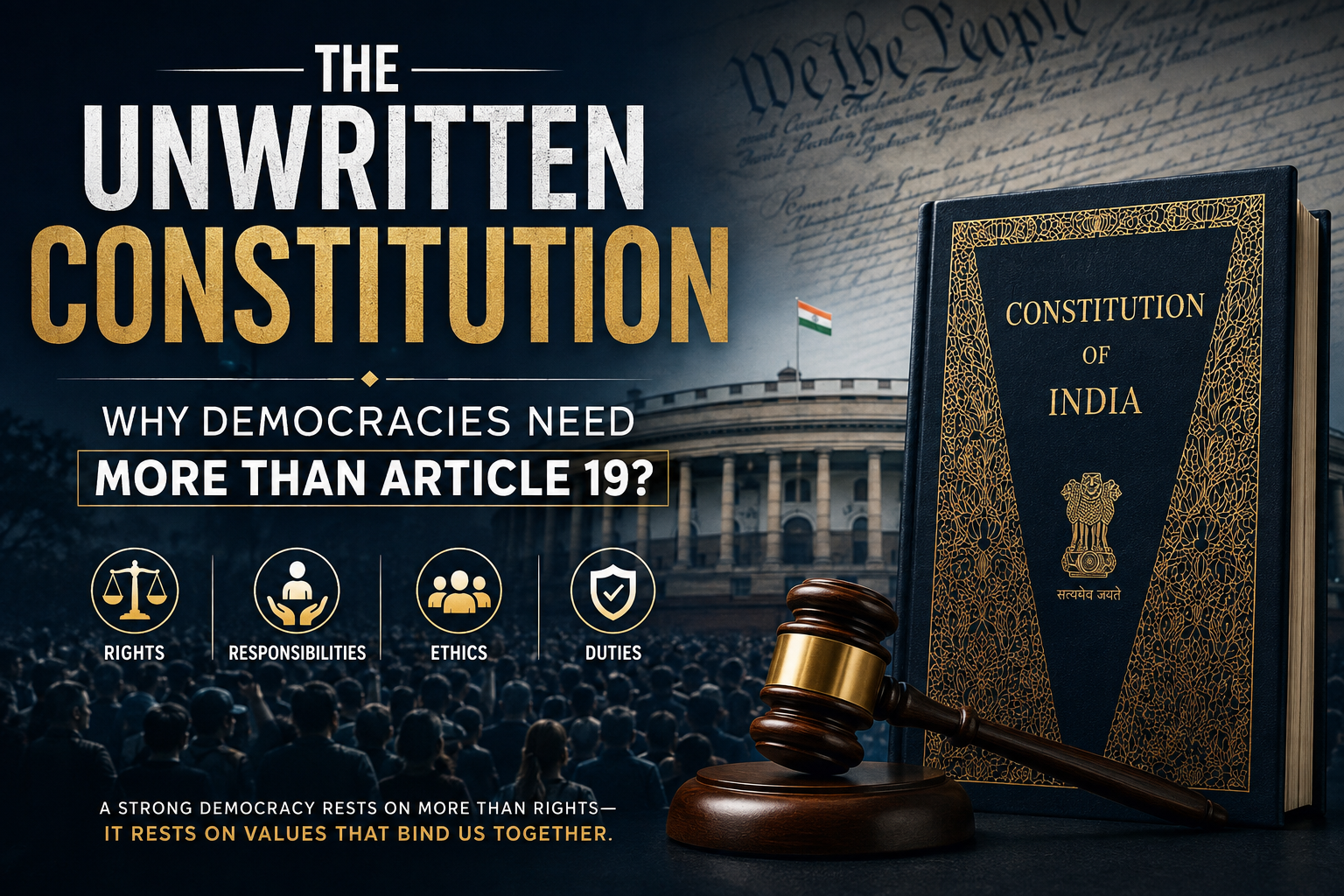
In India’s democracy, we effectively live under two “constitutions.” The written one, the text of Article 19, tells us what the state cannot do to curb our speech. Article 19(2) then enumerates a few narrow grounds for the state to interfere: security, public order, decency or morality, contempt of court, defamation, incitement to an offense. These provisions mean that simply insulting a politician, no matter how crude, rarely crosses the legal line, unless it truly incites violence or public disorder.
No right, after all, is absolute. Courts have repeatedly overturned laws that try to trample legitimate criticism. In Shreya Singhal, for example, the Supreme Court struck down India’s broad ban on online “offensive” content as unconstitutional. The law respects even harsh, irreverent political speech, the price democracies pay for free debate.
But the unwritten constitution, the network of social norms that none of our judges can legislate, works very differently. This is the code by which families, schools and communities live. It says that yelling obscenities at a respected figure is impolite, even if not illegal. It says we owe each other a baseline of civility. We learn these rules outside courtroom chambers. Parents don’t teach their children manners by reading Article 19. School principals don’t hand out grammar and respect by citing Supreme Court rulings. Instead, each generation inherits an understanding of how debate “should” sound.
That unwritten normbook is crumbling. We see it in the current storm over Ruchika Singh’s words. Legal experts will argue about whether the complaint against her even meets the tests of public order or defamation. A High Court might eventually quash the FIR on grounds that the insult was not provocation to violence. Legally, those are reasonable defenses. But framing the fight purely in constitutional terms misses the bigger point. Using criminal charges may not be appropriate.
To be clear, one can vigorously defend Ms. Singh’s right to say crude things about the government without championing the crudity itself. The written Constitution protects a citizen from state overreach, not from social criticism. There is a crucial difference between a statement being legally permissible and it being a good thing to say.
Rage on the Internet
What’s new is the context. Eighteen months ago, this controversy might have stayed confined to an English newspaper column or a TV panel. Today it’s being played out on smartphones and Twitter threads in real time. The raw footage from Jantar Mantar, students chanting, some sputtering explicitswent viral within hours. Platforms don’t care about nuance; they care about what drives clicks. As one Stanford researcher notes, social media today rewards “rage bait” content that provokes outrage. Outrage spreads faster than reason. The algorithms amplify every new outburst because angry posts keep users glued to the screen.
That dynamic reshapes our protests. The Cockroach Janta Party knows that clever slogans and embarrassing memes travel farther than thoughtful debates.
When Rahul Gandhi exclaimed on X that the government “broke their bones” and now is using FIRs on students, it was not a measured parliamentary critique; it was a soundbite designed to cut through the news cycle. The Aam Aadmi Party and Congress often lampoon BJP leaders with graphic caricatures online. These images and insults resonate on social feeds. But they also normalize a style of dissent that other generations might have shunned.
In this digital age of instant broadcasting, every student activist is a journalist with a filter. They film police breaking heads, edit it to rock music, and post with hashtags. They see relatives watching tear‑gas videos on WhatsApp and think, “This is our revolution.” One young protester told Al Jazeera, “Hating Modi is cool on the internet now”.
There is also a cultural strand here that some call “woke politics.” In very broad terms, this worldview classifies society into the powerful and powerless, oppressor and oppressed. If we judge language by who speaks it and who it targets, we break universal standards. In some activist circles today, crude insults are okay if directed at the “oppressor,” but the same words might be denounced as hateful if aimed elsewhere. This identity-obsessed calculus undermines consistency. If X can call Y a “motherfucker” in politics, on what principle do we forbid Y’s supporters from calling X the same? Once double standards creep in, civility is eroded all around.
It’s easier to shout a memorable slogan than to organize long-term change. Many young leaders admit privately that social media presence matters more now than quiet persuasion. Protests are choreographed for YouTube clips: a protester smears himself with mud, or dances holding a placard. These stunts go viral; thoughtful speeches do not. In that ecosystem, obscenity is a shortcut to instant infamy. The crowd cheers, followers pile on, and the protestor gains followers overnight. The actual policy issue, exam paper leaks, for example, gets relegated to a hashtag.
To illustrate: the CJP’s own campaign logos and costumes are designed for meme-ability. They dress as literal cockroaches, spray graffiti, call the education minister “Chaiwala 2.0”, chant salacious verses rewritten for virality. These theatrics helped them fill central Delhi with thousands of young people. But they also normalized a performative, coarse register. The Cockroach Janta Party now stands for “Crude, Juvenile, Provocative.” The point is not to judge CJP’s policy goals, which many agree with, but to notice that their language is purpose-built for maximum shock, not nuance.
Many current debates are framed as binary conflicts: we identify a victim group and an oppressor group. Language is deemed permissible based on group membership. To oversimplify: if you’re marginalized, you can say “N-word” or “cunt” at will; if you’re not, those words are off-limits. This logic might be meant to highlight historical injustices, but it spills over into normal politics. For instance, some of the same liberals who (rightly) condemn racist slurs will shrug at an obscene insult against a powerful politician on social media, arguing “its freedom of speech.” That stance is easy when it’s your ideological enemy on the receiving end. But how long before standards slip and someone’s child, teacher, or religious leader finds themselves insulted? Language barriers, once crossed for one cause, tend to open wide.
Free Speech vs. Social Order
History offers perspective. During India’s independence movement, the tone was fierce but mostly framed in high principles. Leaders called the British thugs, the oppressors, even “Hitler’s trained dogs” in Quit Indiaspeeches, but rarely stooped to vulgar slang. They appealed to morality and reason, not obscenity. In Parliament after 1977, even bitter foes used personal abuse (“you’re no patriot!”), but outright profanity was almost unheard of. The Emergency era saw the forceful rhetoric of ousted opposition leaders, but again, terms like “monster” or “dictator” were used rather than curse words. Our public discourse did get heated , Indira Gandhi called JP Narayan’s movement “treason” and “anti-national” – but it lived under an informal decorum. The elders agreed on an unwritten rule: insults could fly, but they’d stop short of swearing.
That is changing now. The democratization of media means any teenager with a camera has the power to broadcast live to the nation. There are no editors, no party filters, no taste thresholds. A professor in 1990 would not have repeated a street-level expletive on college radio; today a TikTok-savvy kid yells it into a mic before midnight news reaches half as many. Old gatekeepers offered a buffer. Students had to vet their language for college magazines, newsprint or TV. In the new world, censorship is fragmented and inconsistent.
One can defend these changes as a bitter but necessary evolution. Every generation reads its critics more truthfully because they feel the pinch themselves. Gen Z protesters argue: maybe our parents have been coddled. They say the old rules often protected those in power and silenced the weak. We must hear them. But there’s a practical side too. Once public decency slips, it often seeps into private life. If TV talk shows and cable news start bristling with four-letter words, how do we then explain to children that such language is for mature ears only? When uncles swear at political rallies, niece and nephew pick it up too easily.
Thinkers like Edmund Burke warned that society is held together by “little platoons” – families, neighborhoods and local associations, not by formal laws alone. These social units pass on norms of respect and restraint. Alexis de Tocqueville observed that democracy relies on the habits and responsibilities citizens learn over time. Orwell, too, pointed out that sloppy language leads to sloppy thought. All these lessons apply: if we discard all manners in public, no law can require politeness at home. No judiciary can restore a vanished standard of decency by ruling.
The Article 19 conversation needs this broader view. Article 19(2) does list “decency or morality” as reasons to restrict speech, but notice the phrasing: the state may step in if something is obscene or defamatory, not if someone is merely crude. Courts have long said that bad language alone is not criminal unless it crosses into incitement or real harm. Yesterday’s debate on Ruchika Singh’s FIR isn’t about that, it’s about whether we should feel offended, and what to do about it. Here’s the catch: the Constitution tells us what rights the government can’t take away; it doesn’t tell us which insults we should find tolerable.
Our national mantra is that no one is above the law. The law should protect even the speech we dislike. Fair enough. But that principle only keeps the state out of the conversation. It doesn’t make the other half of democracy disappear, civil society. We, the people, still have the choice to condemn or ignore rude speech. We can teach children etiquette even if the police won’t. We can encourage clean debate even if the courts permit filth.
Which brings us back to Nupur Sharma’s case of 2022, for a reality check. When Sharma, a BJP spokesperson, quoted from Islamic texts, the country exploded. There were protests, legal cases, and from extremist corners, actual murder threats. The police recorded open calls for her beheading and even rewards for killing her. Soon, Kanhaiya Lal in Udaipur was tortured and killed by two men on camera for supporting Sharma. Days later, pharmacist Umesh Kolhe in Amravati was murdered in similar fashion after he unwittingly forwarded a group chat meme about her. Those were not mere words. Those were hate-driven murders. In that moment, the country’s liberal voices were silen!
Compare that reaction to what’s happening now. In Sharma’s case, few defended her words. But no one, from secular activists to international diplomats, condemned the calls for violence. Today I hear a contradiction. If yesterday we were silent on Nupur Sharma issue, why are we protecting an activist who uses obscene language?
If a social norm vanishes for one group, it tends to vanish everywhere. Today’s court may say this FIR was a stretch of law. But tomorrow’s parent may wonder why we cheered a four-letter word as political sloganeering.
Democracies Need Self-Restraint
Seventy years from now, when the textbooks recount our era, will they note that we had all the legal freedoms in place, but we celebrated every insult? A democracy’s health is not measured only by black-letter rights, but by whether citizens willingly exercise restraint. The written Constitution may say we are free to say anything short of incitement. But our unwritten constitution, the fabric of mutual respect ,expects more.
The state cannot save the unwritten constitution. The enforcement of civic norms must come from society itself.
Democracies are sustained far less by formal legal codes than by daily social habits. A court can invalidate an unconstitutional law, but it cannot force citizens to listen to one another with patience. Parliament can pass legislation, but it cannot enact a culture of mutual respect.
Those qualities are not created by judicial decree or executive order. They are inherited, nurtured, and passed down through families, schools, local communities, professional associations, and shared social expectations. They are built through the daily discipline of parents teaching children how to disagree without hatred, teachers insisting on reasoned debate in classrooms, editors maintaining editorial standards, and political leaders choosing restraint over short-term viral visibility.
When those mediating institutions fail, the unwritten constitution collapses. And once a culture willingly abandons its habits of self-restraint, no written constitutional text, no matter how brilliantly crafted by its founders, can rebuild what its citizens have thrown away.

Leave a Reply