
- A Rejoinder by Ayush Nadimpalli
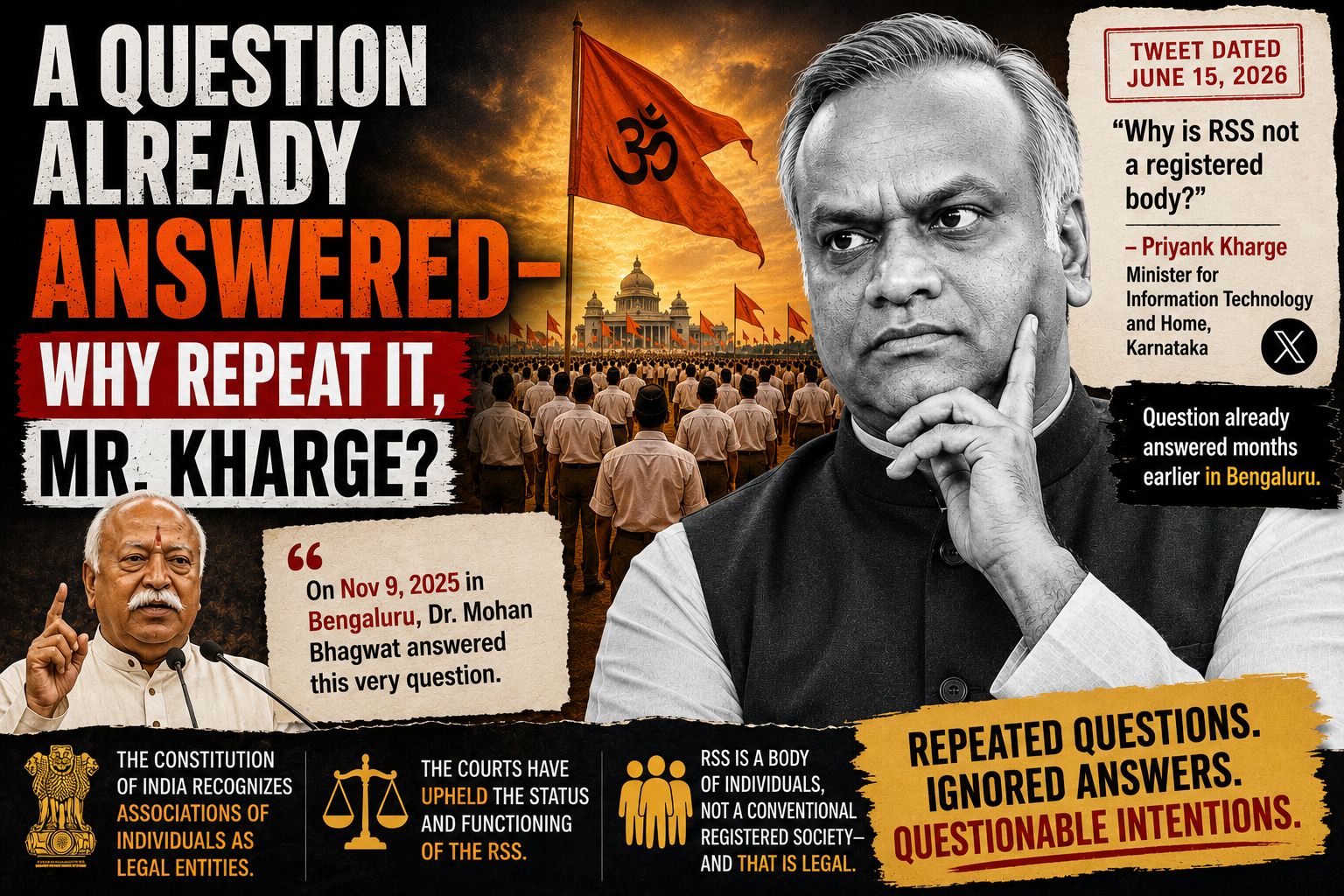
Priyank Kharge’s recent query on why the RSS is not a “registered body” raises a more pertinent question: is this ignorance, or a deliberate attempt to mislead?
Tweet by Priyank Kharge dt 15th June 2026
On November 9, 2025, in Bengaluru itself, RSS Sarsanghchalak Dr. Mohan Bhagwat addressed this very issue in clear terms. Mr. Kharge now claims to have “sent a question” on June 15, 2026. He was the then minister for Information & Technology Minister of Karnataka and it stretches credibility to suggest that he is unaware of a widely discussed clarification delivered in the capital of his own state months earlier. If that was the state of his ministry, he could probably now check the records once again since he is now sworn in as the Home Minister also. This is the link to the entire Q&A Session held on 9th Nov 2025. Link ;
An excerpt to the question being asked reg the registration status of the RSS is here:
This is not a matter of obscure legal nuance. The Constitution of India recognizes “Body of individuals” as valid legal entities. Indian courts, over decades, have also acknowledged the status and functioning of the RSS within this framework. The organization’s structure, by design, is not that of a conventional registered society or trust—and it is fully within its legal rights to function as such.
So why persist with the same question?
When a public figure repeatedly raises an issue that has already been answered—both publicly and legally—it ceases to be inquiry and begins to look like insinuation. The pattern suggests less an effort to seek clarity and more an attempt to cast doubt where none exists.
The Congress party, to which Mr. Kharge belongs, has a long history of engaging with institutions selectively—accepting constitutional provisions when convenient and questioning them when politically expedient. To question the legitimacy of an organization that operates within the bounds of law, and whose status has been implicitly and explicitly accepted over time, reflects a troubling disregard for institutional consistency.
If the intent were genuine, the response would have been acknowledged, debated, or rebutted with substance. Instead, we see repetition—detached from context, and indifferent to prior clarification.
Public discourse deserves better than recycled questions and selective amnesia. If there are new arguments to be made, let them be made openly. But to revisit settled matters under the guise of inquiry is not scrutiny—it is strategy.
And the people of this country can see the difference.
Recommended Reading : –


Leave a Reply